

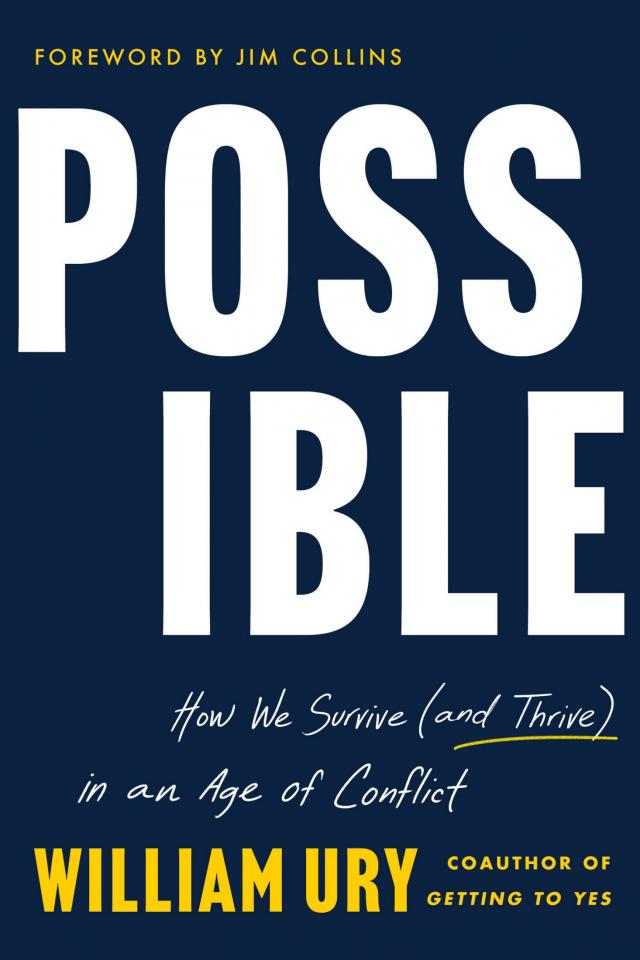
Possible, p.11
Possible, page 11


SEE THE POSSIBILITIES
In this deeply divided world, there is perhaps no more important power for us to activate than to zoom out to see the bigger picture. If we are to tackle today’s challenges with the curiosity, creativity, and collaboration they require, we need to free ourselves from our limiting assumptions about what is and is not possible.
When I look up at the night sky in a city, I see very few stars because of the ambient light. In the mountains, where I am currently writing, far away from city lights, I marvel at the dark sky, thick with twinkling stars. Like the stars, the possibilities in conflict are there. The question is: Can we see them?
Let me invite you to consider a conflict from your life. For a moment, zoom out and identify the various stakeholders, both the people directly involved and those indirectly affected. Ask yourself: Whom am I missing? Whom am I leaving out? Whom should I include? Who can block me—and how? And who can help me—and how?
Zoom out and ask yourself: What is my BATNA? How can I meet my needs if I cannot reach an agreement? How can I develop my BATNA to make it even better? What is my WATNA—my worst alternative to a negotiated agreement? How can I avert the worst and aim for the best?
Zoom out to the future—twenty or fifty or even a hundred years. If possibilists had been hard at work and you were an archaeologist of the future, what artifacts would you find? As you imagine such a future, what next steps could take you in that direction?
Finally, zoom out and consider the game you are playing. This is perhaps the biggest opportunity of all. What could you do to change the game from a win-lose battle to a game of constructive conflict and cooperation?
If you zoom out and consider all these questions, you will likely uncover new possibilities that you had not imagined before.
Zooming out is the culminating move of going to the balcony, our first victory on the path to possible. From the balcony, we begin to see the outline of the golden bridge. This is our next victory to achieve—a victory with the other.
Second Victory
Build a Golden Bridge
My right eye will fall out, my right hand will fall off, before I ever agree to the dismantling of a single Jewish settlement.”
Israeli prime minister Menachem Begin wasn’t leaving much room for negotiation.
It was September 1978. President Jimmy Carter had invited Begin to meet with Egyptian president Anwar Sadat at Camp David, the presidential retreat set in the beautiful wooded hills of Maryland, an hour and a half’s drive from Washington, DC.
Carter had hoped that in this relaxed, informal setting, the two leaders could come to terms on an agreement to end the state of hostilities between their two countries that had led to four devastating wars in thirty years. But after three days of contentious conversation, the parties were deadlocked.
Begin insisted on retaining the Jewish settlements on the Sinai Peninsula, the Egyptian lands that Israel had occupied in 1967 during the third Arab-Israeli War, also known as the Six-Day War.
To Begin’s demand, Sadat replied immovably:
“Never! If you do not agree to evacuate the settlements, there will be no peace.”
Both leaders told their teams to pack their bags. All hope for a Middle East peace agreement seemed lost.
Like the rest of the world, I was immensely surprised when President Jimmy Carter showed up thirteen days later on television, flanked by Sadat and Begin, signing a historic peace agreement in the East Room of the White House.
At the time, I was a doctoral student in anthropology at Harvard, working with Professor Roger Fisher. I had studied the Arab-Israeli conflict and had only recently returned from a long trip to the region. I was painfully aware of the decades-old conflict over land and identity that, in the world’s eyes, had become the very symbol of impossibility.
What was the story behind this astonishing breakthrough? I wondered. How had the leaders managed to build a bridge across the chasm of deep-seated conflict? How, in other words, had they reached agreement to end an interminable war? And what lessons did it have for all of us in transforming seemingly intractable conflicts? If Arabs and Israelis could learn to transform their conflict, perhaps there was hope for the rest of us.
I had been paying close attention to the summit. A few weeks earlier, Roger Fisher had called me into his law school office after he had returned from his summer holiday on the island of Martha’s Vineyard. He had a big smile on his face and sounded excited, as if he had gone fishing and caught a big fish:
“This past weekend, I played tennis with Cy Vance, who happened to be my neighbor’s houseguest. After the game, Cy asked me if I had any negotiation ideas for Camp David. So I brought him over to the house and gave him a copy of our little book. I drew his attention to the part that describes the one-text process and told him he should think about using the process to reach an agreement with Sadat and Begin next week. Can you arrange a meeting right away with Louis Sohn and others to discuss the idea so we can write an advice memo for Vance by Friday?”
Cyrus, or “Cy,” Vance was the US secretary of state. The “little book,” International Mediation: A Working Guide, was a book of practical ideas for negotiators that I had spent the previous year working on with Roger. Never formally published, it was the predecessor and inspiration for Getting to Yes. In the guide, Roger and I had written about the one-text process, a negotiating procedure used with success during the UN multilateral conference on the Law of the Sea. We had first learned about it from Harvard Law School professor Louis Sohn, who had served on the US negotiating delegation.
The one-text, as we called it, is an ingeniously simple alternative to the usual haggling over opposed positions. Instead of pressing for concessions, a third party drafts a possible agreement and asks the parties to give their comments. The third party then continually revises the text to address the concerns until a consensus is reached. The one-text is a way to build a golden bridge.
I set up a dinner at the Harvard Faculty Club the following night for a meeting of the Devising Seminar. The seminar was a series of meetings organized by Roger, to which he would invite professors and visiting diplomats to discuss a particular world conflict in order to “devise” creative solutions. It was an experiment, a lab of sorts. Could we engage in a different kind of conversation that would help create new possibilities in conflicts that seemed impossibly stuck?
Devise was a word Roger liked because it implied practical creativity. The dictionary definition of “devise” is “to form in the mind by new combinations or applications of ideas or principles.” That is a pretty good description of what we were trying to do.
“What is the best advice we could offer Cyrus Vance?”
Roger posed that question to the half-dozen people gathered around the dinner table. I recorded their ideas on a flip chart. Drawing on the ideas, Roger and I then wrote up a three-page memo, focusing on the one-text process, and sent it off to Vance.
In the first three days of the summit, that memo lay unused in Vance’s briefcase. Then, just as the parties were preparing to leave Camp David in failure, President Carter decided to give the talks one last try. He called Vance into his cabin and asked him for advice. Vance remembered the memo and proposed using the one-text process. Carter agreed and asked him to prepare a proposal.
In a conventional process, a third party proposes a line somewhere in the middle between the two positions. Each party often objects vehemently, rejecting the proposal. Since concessions are politically painful, nobody wants to make the first one, fearing that it will signal weakness and open the door to even more concessions.
But the one-text process takes a very different approach. No one is asked to make a concession, at least up front. The focus is not on the concrete positions but rather on how to create options that can satisfy the underlying interests.
So the US mediators went to the Israelis and Egyptians and told them:
“We’re not asking you to change your position. Just tell us more about your interests and needs. What do you really want? And what are you most worried about?”
The Americans listened intently to each side as both shared their aspirations and fears.
The Egyptians emphasized their vital interest in sovereignty. The land had been theirs since the time of the pharaohs, and they wanted it back. The Israelis focused on their vital interest in security. Egyptian tanks had rolled across the Sinai Peninsula three times to attack them, and the Israelis wanted to make certain that would never happen again.
The Egyptians had floated a creative proposal to demilitarize parts of the Sinai. The Americans decided to incorporate the idea into their first draft of the one-text, demilitarizing the Sinai and creating a security buffer for Israel. Basically, the Egyptian flag could fly everywhere but Egyptian tanks could go nowhere. It was an ingenious idea, addressing the Israelis’ concern for security while retaining Egyptian sovereignty.
But in conflict negotiation, it is not enough to have a good idea; you have to get buy-in from the parties. People usually don’t trust ideas that are not theirs.
The one-text process keeps the draft proposal highly informal so it can easily be revised to incorporate ideas and suggestions from the parties. There is no letterhead on the draft, no attribution, no status. It is a non-paper. It might even have coffee stains on it.
“This is not an American proposal,” said the Americans to the parties. “It’s just an idea. We are not asking you for a decision. Actually, we don’t want a decision at this point. We just want you to let us know what you think of it. Feel free to criticize it. The more criticism, the better. Where does the draft not address your core interests? Where is it unfair?”
In heated conflicts, I have found, nobody wants to make a painful decision, but everybody loves to criticize.
The Israelis criticized the US text heavily. So did the Egyptians. The Americans then went back to their cabin and redrafted the text, trying to improve it for one side without making it worse for the other.
To address Israeli security concerns about an Egyptian surprise attack, President Carter added to the text the offer that US military and contractors could participate in the monitoring of the demilitarization. The latest technology could track even a goat crossing the solitary desert.
Then the US mediators brought the draft back.
“We’ve worked on it some more to take into account what you said. Again, we don’t want a decision at this point, just more criticism and suggestions so we can make it better.”
Each time the one-text improved, the parties saw not only their needs addressed but their ideas and language incorporated into it. They began to buy in.
The mediators repeated the same process again—and again—revising the draft and consulting the parties. In a very long week, they produced twenty-three separate drafts.
As everyone’s patience began to wear thin and the parties grumbled that they were being held prisoner, President Carter presented the final draft to President Sadat and Prime Minister Begin separately and said:
“I know it is not everything you want, but here is the best we have been able to do. At this point, I am asking you to decide what is best for you.”
Now the two antagonists were faced with a much simpler and more attractive decision than in the conventional negotiation process of haggling over positions. Instead of having to make multiple painful concessions up front without knowing exactly where the process would end, they had to make only one decision and only at the very end, when they could see exactly what they would get in return.
President Sadat could see that he would get the entire Sinai Peninsula back for Egypt.
Prime Minister Begin could see that he would get an unprecedented historic peace.
Separately, each leader said yes. Carter and his colleagues were euphoric. Everyone prepared to go to Washington for the formal signing at the White House.
Then, as so often happens in difficult conflicts, there was a last-minute blowup. A bridge had been built, but the parties were nervous about stepping on it with their full weight.
Begin flew into a rage, triggered by a proposed side letter Carter had promised to Sadat. In that letter, Carter had reconfirmed the long-standing US posture of neutrality on the status of Jerusalem, a raw nerve for the Israelis. Begin broke off the talks and ordered his delegation to withdraw.
Bitterly disappointed, Carter walked over to Begin’s cabin to say goodbye. He brought with him signed photos of the three leaders together—Begin, Sadat, and himself. Earlier in the week, Begin had requested one photo for each of his eight grandchildren. Carter had signed each photo, but instead of writing his usual “Best wishes,” he had written “With love” and added the name of each grandchild. He had paid careful attention and knew how much Begin’s grandchildren meant to him.
“Mr. Prime Minister, I brought you the photographs you asked for.”
“Thank you, Mr. President.”
Begin looked coolly at Carter, but when he glanced down and saw written on the top photo, “To Ayelet,” he froze for a moment. When he looked at the next one, “To Osnat,” his lip trembled and his eyes filled with tears. He read each of the eight names aloud—“Orit,” “Meirav,” “Michal”—and he began to weep openly.
Carter spoke up, his voice breaking.
“I wanted to be able to say, ‘This is when your grandfather and I brought peace to the Middle East.’”
The two men began to talk, this time in a new tone. Begin was quiet, even friendly, but still firm about his decision. He asked Carter to withdraw the side letter, but Carter gently yet firmly explained that he was willing to let the talks fail rather than break the personal promise he had made to Sadat.
But as Carter prepared to leave, he quietly mentioned to Begin that he had rewritten the letter, merely citing the US position “as stated by Ambassador Goldberg in the United Nations General Assembly on July 14, 1967.” He had left out what that position was. He asked Begin to read it again with an open mind.
Pensive, with a heavy heart, Carter walked back to his cabin, where he met Sadat and told him the bad news. Within hours the whole world would know of the failure at Camp David with all its likely consequences for new wars. Then the phone rang. It was Begin.
“I will accept the letter you have drafted on Jerusalem.”
I can remember vividly hearing this story directly from Jimmy Carter a few years later, as I was accompanying him on a mission to help stop the civil wars then ravaging Sudan and Ethiopia. It touched me and gave me a real sense of how even complex high-level negotiations like this can come down to human beings grappling with human feelings and seeing the humanity in one another.
The historic signing of the Camp David Accords proceeded to take place, surprising the entire world.
It was just a beginning, of course. The Arab-Israeli conflict was far from resolved. The agreement failed to address the legitimate needs of the Palestinian people. Sadat himself fell victim to an assassin’s bullets just a few years later. But the peace forged during those thirteen days has now endured more than forty years through revolution, coup d’état, and other wars in the region. Against all odds, the talks at Camp David succeeded in transforming destructive confrontation into peaceful coexistence.
The conflict did not end, but the war did. And that made all the difference.
The dramatic story of Camp David deeply influenced me at the very outset of my life’s work in negotiation. By so clearly demonstrating that even the most seemingly impossible of conflicts could yield a transformative outcome, the accords confirmed my belief in our human potential and cemented my commitment to becoming a practicing possibilist.
BUILD A GOLDEN BRIDGE
When I was six years old, my family and I traveled to San Francisco from Europe by ship. Passing under the Golden Gate Bridge made an enormous impression on me, as we floated between its tremendous towers and under its huge span and sweeping cables. We moved into a house not far from the bridge on the other side from the city. I crossed the bridge countless times as a boy in a car and sometimes on foot and bicycle. I came to love that bridge, and it is the image that comes to mind often in my work.
Building a bridge may be the most common metaphor for the process of trying to reach agreement and foster a relationship between adversaries. In intractable conflicts such as the Egyptian-Israeli conflict, a giant chasm separates the two sides, filled with dissatisfactions and distrust, unmet needs and insecurities. How can we possibly bridge such a gap?
In conflict, our tendency is to push for our position. After all, our position may seem utterly reasonable to us. But what does the other side usually do when we push? Naturally, they push back. We end up in an impasse, as happened in the first three days at Camp David.
How can we get out of this trap? Successful negotiators, I have long observed, do the exact opposite: Instead of pushing, attract. Instead of making it harder for the other side, make it as easy and as attractive as possible for them to say yes to the decision you would like them to make.
In The Art of War, a brilliant treatise on military strategy written twenty-five hundred years ago, the Chinese general and philosopher Sun Tzu emphasized the importance of leaving your enemy a way out. This phrase has often been translated as “Build your opponent a golden bridge to retreat across.” In my book Getting Past No, written decades ago, I reframed this principle as building a golden bridge for the other party to advance across. I have been teaching this precept ever since.
A golden bridge is an inviting way for the parties to cross the chasm of conflict.
I believe that the story of Camp David holds an important lesson for us as we face the seemingly impossible conflicts of today. Though the context is different, the similarities are telling. Today as then, fear, anger, and pride have taken over. So many parties are entrenched in rigid ideological positions, refusing to budge like Begin when he declared that he would rather lose his right eye and right hand than change his position. There seems to be no way out other than to resort to destructive fighting.






