

Wilde complete plays, p.1
Wilde Complete Plays, page 1


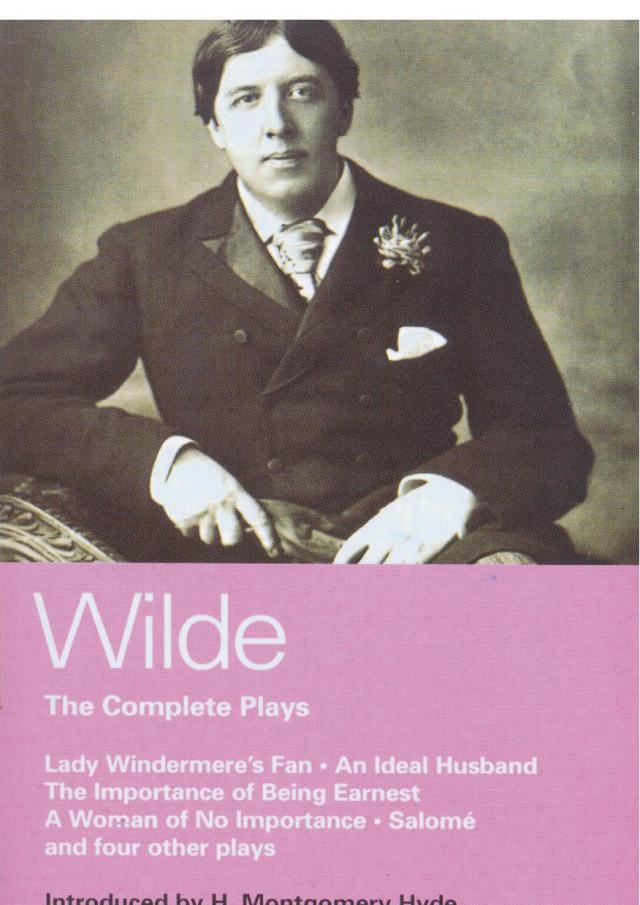
Oscar Wilde
The Complete Plays
Lady Windermere’s Fan, An Ideal Husband,
The Importance of Being Earnest, A Woman of
No Importance, Salomé, The Duchess of Padua,
Vera, or The Nihilists, A Florentine Tragedy,
La Sainte Courtisane
This volume contains Wilde’s four full-length plays,
including his masterpiece, The Importance of Being
Earnest–printed here in its usual three-act form, but with an appendix containing the best material from the original
four-act version. Also included is Salomé, the play which was banned by the Lord Chamberlain in 1892 on the grounds that
it introduced biblical characters on stage (the play was later
performed by Sarah Bernhardt in Paris in 1896), and other
less well-known plays by Wilde, two in verse.
H. Montgomery Hyde, an acknowledged expert on Wilde and
author of several books on him, has provided an introduction
to Wilde’s life and work with special attention to the
composition and performance of the plays.
Oscar Wilde was born in Dublin in 1856. In the years
following his graduation from Oxford in 1878 he published
poems and stories which included The Picture of Dorian
Gray. Lady Windermere’s Fan was produced in 1892, A
Woman of No Importance in 1893 and An Ideal Husband and The Importance of Being Earnest in 1895. Later work
included De Profundis and The Ballad of Reading Gaol. He died in 1900.
2
Methuen World Classics
include
Jean Anouilh (two volumes)
John Arden (two volumes)
Arden & D’Arcy
Brendan Behan
Aphra Behn
Bertolt Brecht (six volumes)
Büchner
Bulgakov
Calderón
Anton Chekhov
Noel Coward (seven volumes)
Eduardo de Filippo
Max Frisch
John Galsworthy
Gorky
Harley Granville Barker (two volumes)
Henrik Ibsen (six volumes)
Lorca (three volumes)
Marivaux
Mustapha Matura
David Mercer (two volumes)
Arthur Miller (five volumes)
Molière
Musset
Peter Nichols (two volumes)
Clifford Odets
Joe Orton
A. W. Pinero
3
Luigi Pirandello
Terence Rattigan (two volumes)
W. Somerset Maugham (two volumes)
August Strindberg (three volumes)
J. M. Synge
Ramón del Valle-Inclán
Frank Wedekind
Oscar Wilde
4
OSCAR WILDE
The Complete Plays
Lady Windermere’s Fan
An Ideal Husband
The Importance of Being Earnest
A Woman of No Importance
Salomé
The Duchess of Padua
Vera, or The Nihilists
A Florentine Tragedy
La Sainte Courtisane
Introduced by H. Montgomery Hyde
5
Contents
Cover
Title Page
Oscar Fingal O’Flahertie Wills Wilde:
A Chronology
Introduction
Lady Windermere’s Fan
An Ideal Husband
The Importance of Being Earnest
Appendix: The Gribsby Scene from The Importance of Being
Earnest with an explanatory note
A Woman of No Importance
Salomé
Duchess of Padua
Vera, or The Nihilists
A Florentine Tragedy
La Sainte Courtisane
6
Footnote
Imprint
7
Oscar Fingal O’Flahertie Wills Wilde:
A Chronology
16 OctoberBorn at 21 Westland Row, Dublin, the second
1854
son of Sir William Wilde, aural surgeon, and
Jane Lady Wilde, the Irish Nationalist poetess
(Speranza).
1865–1871 At Portora Royal School, Enniskillen.
1871–74
At Trinity College, Dublin, Scholar and winner
of Berkeley Gold Medal for Greek.
1874–78
At Magdalen College, Oxford. Wins Newdigate
Prize for English Verse (Ravenna), and gains
‘Double First’ in university degree examinations.
1876
Father Sir William Wilde dies in Dublin, aged
61.
1880
Writes Vera; or the Nihilists.
1881
Collected Poems published; goes into four
editions.
1882
Undertakes extensive lecture tour of the United
States and Canada, his subjects being ‘The
8
English
Renaissance
of
Art’,
‘House
Decoration’, ‘Art and the Handicraftsman’, and
‘The Irish Poets of ’48’.
1883
Writes The Duchess of Padua.
1884
Marries Miss Constance Lloyd, daughter of Mr.
Horatio Lloyd, Q.C., at St. James’s Church,
Paddington.
1887–89
Editor of The Woman’s World for Cassell’s.
1888
Publishes The Happy Prince and Other Tales.
1889
The Portrait of Mr. W.H. published in
Blackwood’s Edinburgh Magazine (July).
1890
The Picture of Dorian Gray published in
Lippincott’s Monthly Magazine (June).
1891
Meets Lord Alfred Douglas for first time. The
Soul of Man Under Socialism published in The
Fortnightly Review (February). The Picture of
Dorian Gray republished in book form with
numerous
alterations
and
additions.
Also
publishes Intentions, Lord Arthur Savile’s Crime
and
Other
Stories,
and
A
House
of
Pomegranates.
9
20 February Lady Windermere’s Fan first performed at the St.
1892
James’s Theatre.
Writes Salome in French. Sarah Bernhardt, the
leading French actress, agrees to play title role
and the play is being rehearsed in London when
the
Lord
Chamberlain
bans
its
public
performance on the ground that it introduces
Biblical characters, whose appearance on the
stage was then forbidden.
1893
Publishes Salome in simultaneous French and
English edition. A later English edition (1894)
appeared, with illustrations by Aubrey Beardsley.
19
April A Woman of No Importance first performed at
1893
the Theatre Royal, Haymarket.
1894
Publishes The Sphinx with ‘decorations’ by
Charles Ricketts. Lord Queensberry threatens to
disown his son Lord Alfred Douglas unless he
ceases to associate with Wilde, and Douglas
refuses.
Publication
of
The
Chameleon
containing Wilde’s ‘Phrases and Philosophies for
the Use of the Young’.
Wilde also writes La Sainte Courtisane and A
Florentine Tragedy at this time.
10
3
January An Ideal Husband first performed at the
1895
Hay-market theatre.
14 February The Importance of Being Earnest first performed
at the St. James’s Theatre. Queensberry, who is
denied admission to the theatre with the intention
of creating a scene, calls at Wilde’s club four
days later and leaves his card for Wilde with an
inscription accusing Wilde of posing as a
sodomite.
28 February Wilde receives Queensberry’s card and decides
to prosecute him for criminal libel.
1 March
Queensberry arrested and committed for trial.
3 April
Queensberry trial opens at Central Criminal
Court (Old Bailey) before Mr. Justice Henn
Collins and a jury.
5 April
Wilde withdraws prosecution, on his counsel’s
advice, and Queensberry is acquitted. Arrested
later same day. Bail refused.
26
April-7Tried jointly with Alfred Taylor on homosexual
May
charges at the Old Bailey before Mr. Justice
Charles a nd a jury. Jury disagrees on principal
11
counts of indictment. Wilde released on bail of
£5,000.
20–25 May Tried before Mr. Justice Wills and jury, Taylor
being tried separately. Both found guilty and
sentenced to two years imprisonment with hard
labour. Taken to Pentonville prison.
4 July
Transferred from Pentonville to Wandsworth.
26 August Adjudicated bankrupt.
12
Public examination in bankruptcy.
November
20
Transferred from Wandsworth to Reading.
November
3 FebruaryMother Lady Wilde dies in London, aged 70.
1896
11 February Salome first performed at the Théâtre de
L’Oeuvre, Paris.
February
Constance Wilde granted custody by Chancery
1897
Court in London of their two children Cyril and
Vyvyan, with herself and her cousin Adrian
12
Hope as guardians. The children’s surname was
subsequently changed from Wilde to Holland.
March
Completes De Profundis in the form of a long
letter to Lord Alfred Douglas.
19 May
On his release from prison, travels by night boat
to Dieppe where he is met by Robert Ross, to
whom he entrusts the manuscript of De
Profundis for copying and arranging that a typed
copy is sent to Douglas.
June-AugustSettles at Berneval, near Dieppe, and writes the
greater part of The Ballad of Reading Gaol there.
September Reunited with Douglas in Rouen, going on to
Naples where they take a furnished villa and
Wilde finishes The Ballad. They eventually
separate for financial reasons, since Wilde’s wife
had stopped the allowance she made him when
she heard that he was living with Douglas.
March 1898 The
Ballad
of
Reading
Gaol
published
pseudonymously (‘By C.3.3.’) by Leonard
Smithers. During next three months it goes into
six editions.
13
7 April
Constance Wilde dies in Genoa, aged 40, and is
buried in the Protestant cemetery there. Adrian
Hope continues as the children’s sole guardian.
1899
Seventh edition of The Ballad of Reading Gaol
published with the addition of the author’s name
in brackets after the pseudonym on the title page.
30
Wilde dies of meningitis in the Hotel d’Alsace,
November Rue des Beaux Arts, Paris, having shortly before
1900
been received into the Roman Catholic Church.
Robert Ross constituted literary executor.
Douglas pays the funeral expenses.
1905
De Profundis first published in a drastically
expurgated edition, with a preface by Robert
Ross, which gives no indication that it is part of a
much longer letter to Douglas. Salome, which
had been set to music as an opera by Richard
Strauss, has its first performance at the Royal
Opera House, Dresden.
1906
Wilde estate declared solvent through payment of
final dividend which gives creditors in his
bankruptcy 20 shillings in the pound, together
with 4 per cent interest.
1908
First Collected Edition of Wilde’s works issued
in fourteen volumes, under the general editorship
14
of Robert Ross, thirteen by Methuen & Co., London, and one (The Picture of Dorian Gray)
by Charles Carrington, Paris.
1909
Wilde’s
remains
removed
from
Bagneux
cemetery in Paris, where they had been originally
interred, to their present resting place in Père
Lachaise, in the presence, among others, of
Robert Ross and Wilde’s younger son Vyvyan
Holland. Manuscript of De Profundis presented
by Robert Ross to the British Museum on
condition that it should not be opened to the
public until 1 January i960, by which date it was
assumed that Douglas and everyone else
mentioned in the manuscript would be dead.
1912
Large sculpture by Jacob Epstein erected over
Wilde’s grave in Père Lachaise.
April 1913 Portions of the unpublished parts of De
Profundis read out in court during the trial of a
libel action brought by Lord Alfred Douglas
against Mr. Arthur Ransome, author of Oscar
Wilde: A Critical Study, an action which Douglas
loses and which makes him bankrupt.
5
OctoberRobert Ross dies, having expressed wish in his
1918
will that after cremation his ashes should be
transferred to Wilde’s tomb in Père Lachaise.
15
20
MarchDeath of Lord Alfred Douglas.
1945
30
Fiftieth anniversary of Wilde’s death marked by
November graveside ceremony at Père Lachaise, when the
1950
tomb is opened and Robert Ross’s remains are
placed beside Wilde’s by Mrs. Margery Ross,
niece of Robert Ross, in accordance with his
wishes. Panegyric delivered by Jean-Joseph
Renaud, French fencing champion, who had
known Wilde in his last years in Paris and had
translated Intentions into French after his death.
16 OctoberRehabilitation completed by the erection by the
1954
London County Council of a plaque on the
outside wall of Wilde’s home in Tite Street,
Chelsea, recording the fact that ‘Oscar Wilde, wit
and dramatist lived here’. The plaque is unveiled
by Sir Compton Mackenzie in a well-attended
and impressive public ceremony, at which H.
Montgomery Hyde, M.P., presides. A similar
plaque erected by the Dublin authorities on the
wall of the house where Wilde was born is
unveiled on the same day by the Irish playwright
Lennox Robinson.
1
JanuaryComplete manuscript of De Profundis unsealed
1960
and opened in the British Museum. H.
Montgomery Hyde is the first member of the
general public allowed to examine it.
16
Introduction
I
Lady Windermere’s Fan was Wilde’s first success in the
theatre, and the first of his plays to be performed in England.
Prior to its original production, in 1892, he had written two
serious dramatic works, Vera, or The Nihilists and The
Duchess of Padua, both historical in character, but had failed to find an English producer for either, although The Duchess
of Padua, which was in blank verse, had been produced under
the title Guido Ferranti in New York in 1891: however, it
was withdrawn after only twenty-one performances, but it
was included in the theatre’s repertory during its subsequent
provincial tour where it was given a few additional showings.
Disheartened by this failure, Wilde now determined to try his
hand at modern comedy.
In fact, the suggestion that he should do so came from his
friend George Alexander, who had played the male leads for
several years under Henry Irving at the Lyceum Theatre in
London and had recently emulated Irving by becoming the
lessee of another London theatre, the St. James’s, as
actor-manager. When they met and discussed the project,
Alexander gave the author £50 for an option on the play,
which Wilde gladly accepted as he was pressed for money at
this time and was largely dependent on his wife’s small
private income. But the art of the playwright does not come
easily, even to the most gifted, which Wilde undoubtedly was.
At first he found the going so hard that he despaired and even
thought of abandoning the play altogether and giving
17
Alexander his money back. ‘I am not satisfied with myself or my work,’ he wrote to Alexander on 2 February 1891. ‘I can’t
get a grip of the play yet: I can’t get my people real. The fact
is I worked on it when I was not in the mood for work, and
must forget it, and then go back quite fresh to it. I am very
sorry, but artistic work can’t be done unless one is in the






