

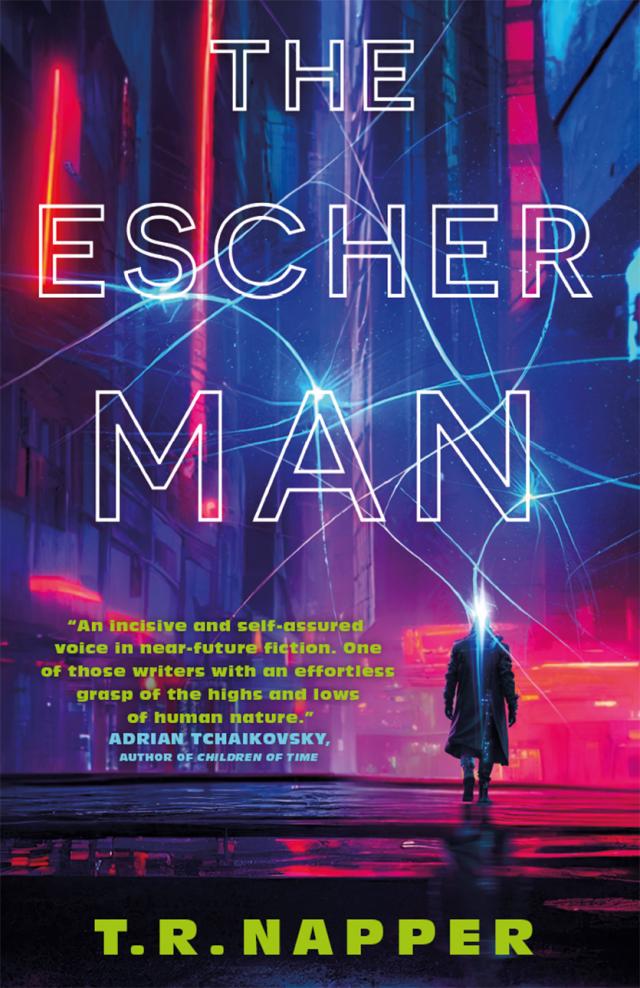
The escher man, p.1
The Escher Man, page 1


Contents
Cover
Title Page
Leave us a Review
Copyright
Dedication
A Note on Foreign Language Usage
Part One The Memory Hole
1
2
3
4
5
6
7
8
9
10
11
12
13
14
15
Part Two Memory Town
16
17
18
19
20
21
22
23
24
25
26
27
28
29
30
31
32
33
34
35
36
37
38
39
40
41
42
43
44
45
46
47
48
49
50
Part Three The Escher Man
51
52
53
54
55
56
57
58
59
60
61
62
Acknowledgements
About the Author
Praise for T. R. Napper and The Escher Man
“An incisive and self-assured voice in near-future fiction. One of those writers with an effortless grasp of the highs and lows of human nature. Always a joy to read.”
Adrian Tchaikovsky, Arthur C. Clarke and Hugo Award-winning author of Children of Time
“A couple of years ago, I said I couldn’t wait to see where T. R. Napper’s science fiction would take me next. Turns out, it was worth the wait.”
Richard Morgan, author of Altered Carbon
“Brace yourself, this is the future, but not as you remember it… it’s more badass.”
Pat Cadigan, Arthur C. Clarke and Hugo Award-winning author of Synners and Fools
“T. R. Napper shows true genius in his storytelling, with a compelling plotline, noirish setting, and characters of true depth.”
Kaaron Warren, author of The Underhistory
“This is one hell of a read. T. R. Napper is back on his quest to be the reigning successor to Burning Chrome, Altered Carbon, Synners and Ghost in the Shell. And it’s definitely working. The Escher Man gripped me from the very first scene and never let go. This is the new face of cyberpunk.”
Yudhanjaya Wijeratne, author of The Salvage Crew
Also by T. R. Napper
and available from Titan Books
36 Streets
Ghost of the Neon God
LEAVE US A REVIEW
We hope you enjoy this book – if you did we would really appreciate it if you can write a short review. Your ratings really make a difference for the authors, helping the books you love reach more people.
You can rate this book, or leave a short review here:
Amazon.com,
Amazon.co.uk,
Goodreads,
Barnes & Noble,
Waterstones,
or your preferred retailer.
The Escher Man
Print edition ISBN: 9781803368153
E-book edition ISBN: 9781803368160
Published by Titan Books
A division of Titan Publishing Group Ltd
144 Southwark Street, London SE1 0UP
www.titanbooks.com
First edition: September 2024
10 9 8 7 6 5 4 3 2 1
This is a work of fiction. All of the characters, organizations, and events portrayed in this novel are either products of the author’s imagination or are used fictitiously. Any resemblance to actual persons, living or dead (except for satirical purposes), is entirely coincidental.
© T. R. Napper 2024.
T. R. Napper asserts the moral right to be identified as the author of this work.
No part of this publication may be reproduced, stored in a retrieval system, or transmitted, in any form or by any means without the prior written permission of the publisher, nor be otherwise circulated in any form of binding or cover other than that in which it is published and without a similar condition being imposed on the subsequent purchaser.
A CIP catalogue record for this title is available from the British Library.
To Kazuo Ishiguro, a realist of a larger reality.
And to my son, Robert. This is the third book I’ve dedicated to you, but I love you and I’m not going to stop. Even when you become a teenager, and find the whole thing embarrassing. Especially then.
A Note on Foreign
Language Usage
By English-language convention, character names do not use diacritics or tone markings, nor do country names. However, all other foreign words use diacritics or tone markings where appropriate, except where a non-native speaker is using them (because the speaker is not using tones). This may sound a little complicated, but I swear you won’t even notice.
PART ONE
The Memory Hole
The palest ink is better than the best memory.
– Chinese Proverb
1
People would try to do one of three things when I was about to kill them: bribe me, beg me, or pretend they didn’t know me. A bribe could be any number of things, but it was usually money. The rational proposal that their counteroffer was of greater value than what I’d been paid for the hit. Begging was usually an emotional reference to family – I’ve got three kids to feed, I love my wife – that sort of inconsequential bullshit. Chances were, if it got to the point where I was paying them a visit, they hadn’t made family the most important thing in their life. The last was ignorance, feigned: I don’t know you, I’ve never seen you before – like it’s all a simple case of mistaken identity.
I never understood that one. Bribe me, beg me, but don’t bullshit me.
The guy looking up at me was trying to do just that. Fred ‘the Rake’ Bartlett: westerner, Former United States, business suit, crumpled now with blood on the dark grey lapel. He had a full head of brown hair that probably wasn’t natural and he was smaller than you’d think, given his occupation. The product in his hair held it neatly in place, even after the beating I’d given him.
His apartment was far more tasteful than anticipated. I was expecting oversized gold throw cushions, monogrammed bathrobes, maybe a large painting of a tiger eating its prey. The usual gangster bullshit. But his place was surprisingly understated. Minimalist white-and-red furnishings, brass fittings in the kitchen, nondescript art on the walls. Down one corridor I’d glimpsed a door with the letter S on it, sparkling with glitter.
The floor-to-ceiling windows provided a generous view of the city: the mammoth, bulging structures of the casinos draped in their eternal neon. The hard perpetual rain that drew a thin veil over it all. Macau – that steaming, throbbing gambling mecca; the dark underbelly of the Chinese Dream; the gaudy, glittering, and unapologetic face of its power.
Bartlett was seated with his back to the windows, dripping blood onto his white lounge. He was a nobody, really – a middle manager in an ice-nine drug cartel who had been fool enough to try cutting in on Mister Long’s territory. The memory of dinner, two nights ago, was burned deep:
Alone, eating chilli clams sautéed in beer, fresh-baked bread on the side and a large glass of whisky, straight up. The clams were real, so the dinner was expensive, but someone in my line of work ain’t saving for retirement, as a rule. The two small rooms of A Lorcha were cosy, friendly, and filled with the tantalising smells of baked seafood and crisp soy chicken. Conversations in Cantonese and Mandarin and Portuguese washed around me while I dipped the fresh bread in the clam sauce and savoured the reason this was my favourite spot in town.
The front door opened and a short guy (who I later learned was Fred Bartlett) sauntered over, cigarette dangling from his lips, a goon on either side of him. He had a gun in his belt that only I could see from this angle, sitting at a small table in the back corner of the second room. The guys with him were big shouldered: one Filipino, one white. The white guy had a shaved head and teeth that glinted metallic blue – a nano-alloy affectation wannabe gangsters had taken to implanting lately. The Filipino wore a white fedora and the calm, coiled stance of a professional fighter.
Bartlett had this grin on his face that made me want to break a chair across it. He said: “Endgame Ebbinghaus, in the flesh.” He made a show of looking me over. “I guess I thought you’d be more intimidating. Solid titanium limbs, tattooed skull, a dick that shoots flames – that sort of thing.”
I slugged half my whisky and said: “I have no idea who you are. And the woman who takes the reservations here is more intimidating than you.”
The grin stayed on his face, though it strained a little. He took a drag on his cigarette, blowing the smoke out through his nose. “I have a feeling you’ll remember me after this,” he said, and pulled the pistol from his belt.
I’d looked down the barrel of enough guns not to get too flustered by this one, but it’s never a pleasant experience. Quiet rippled through the restaurant as heads turned to watch. A table of three got up slowly to leave; one of the goons pointed at them and mad
So, yeah – I’ve looked down enough barrels to know there’s one thing you never do: hesitate.
I threw the table up with both hands, the edge slammed into Bartlett’s wrist, making him fire a shot into the ceiling. I followed in one smooth motion with a straight right to the man with glittering teeth, using the full force of the augmented joints in my shoulder and knees as I rose with the punch. His head snapped back and he crashed into the table behind as he fell.
The Filipino was already moving, kicking low. I checked it. He flowed smoothly into a high kick. I stepped back; the blow didn’t come close.
I smiled at him. He didn’t like it.
He came at me hard, as expected, I moved inside to meet his charge, ducking and ramming my elbow into his face. The Filipino staggered, I grabbed him by the collar before he could fall and hefted him above my head, easily. The titanium sockets in my arms clicked and whirred softly.
I paused to savour the moment while Bartlett scrambled for his gun and patrons gasped or screamed or quietly cried. I laughed, though I’m not sure why, and then hurled the Filipino, knocking Bartlett backwards and over a chair. But the blow didn’t hit square, and the runt had sufficient adrenaline and panic coursing through him to pick himself up and fly out the front door.
I didn’t bother following him. Men that careless were easy enough to track down, and my main concern at that moment was finding a new spot for dinner.
I surveyed the mess. The Filipino groaned, but stayed down. The white guy was out cold, marinating in the beer and garlic prawns from the table he’d taken with him on the way down. I walked over to where the manager, a short Portuguese woman, was standing behind the bar. Her usual expression was harried and stern, with a touch of you-must-be-fucking-kidding-me when confronted by an atypically stupid customer. But now her mouth was parted in shock, and she had this look on her face like she was seeing me for the first time. I got that a lot.
I was mildly disgusted at myself for the scene I’d made, but outwardly I kept my face hard as carved wood as I threw a bundle of currency onto the counter.
I said: “I seem to have spilt my dinner. This is for the mess, and the meals of the patrons here whose evening I interrupted.”
She took the fat roll of yuan and weighed it in her hand, then eyed me. In Portuguese, she said: “[We don’t have any associations here.]”
“This isn’t the start of one,” I replied.
“[We can handle security just fine.]”
“Lady, I’m just here for the clams.”
She thought it over, lips pressed together, then closed her hand around the money. When I lingered, her familiar temperament returned: “[Well don’t just stand there, clogging up my bar with all that shoulder and chin.]” She nodded at the door. “[Get out of here.]”
“I’ll see you next week.”
She eyed the two thugs groaning on the ground, the splatters of red wine and broth on tablecloth and wall, and the shocked customers whispering emergency calls into their cochlear implants. “[Better make it two.]”
Hard to credit the tough-guy grin and trigger-happy disposition with the beaten-down, pleading little creature here in front of me now. But that is always the test of the mettle of a gangster: how they face death. Most failed in my experience – they begged or wept or wet their pants, and I went ahead and killed them all the same.
Bartlett wiped away the blood from his mouth, his hand shaking. “I don’t know what you’re talking about,” he said, his voice higher than I remembered. “I’m not a drug dealer. I’m a nanotech designer at Baosteel Technology.”
“You’re saying you don’t remember me?”
“I’ve never seen you in my life.”
I seated myself opposite on the tasteful white-and-red faux-leather lounge. I nodded at him, impressed. “Comfortable.”
He kept giving me the scared shitless look.
I said: “You should have left town while you could.”
“Huh?” His pretence of confusion was very convincing. Imminent death has inspired some of the great acting performances, and Fred was angling for Best New Talent at the Shanghai Film Festival.
“It’s always the most logical response. You mess with the wrong people here, you’re dead. Macau is the most unforgiving town on Earth. Indifferent, too – just swallows you up into its black bottomless maw, and not a shred remains. Not even a memory. Everybody knows this, yet everyone believes this somehow doesn’t apply to them. So here you are, sitting in your nice apartment, trying to disbelieve the bullet that’s about to enter your brainpan.”
His eyes were wide open. When he spoke he made sure to verbalise each word, slowly. “Mister. I’ve never seen you before in my life. I swear.”
I placed the pistol on the armrest, pulled a packet of Double Happiness cigarettes from my pocket, and tapped one out. I lit it, snapping the heavy lighter shut, and drew the biting nicotine hit into my lungs. I sighed through my nose, blowing out the smoke. “Cigarette?”
“No I…” He took a deep breath. “Are you really going to kill me?”
“You’ve been in this business as long as me, Bartlett. I’m going to paint that nice view behind you with your brains.”
His lip quavered, tears welled. I shifted in my seat. I’m not sure why, but seeing a grown man cry made me more uncomfortable than beating one to death. When the first tear rolled down his cheek I stood up, stepped over, and slapped him.
He looked up at me, eyes glistening, hand at the spot where I hit him.
I held out the pack. “You need a cigarette.”
Bartlett cleared his throat, then took one, hand shaking. I lit it for him. He inhaled deep, sucking on that stick like he was giving head to the last moment of his life. Then he started coughing, hard, as though it was the first time he’d smoked. At first I thought he was faking it, that maybe he was looking for a chance to grab at my pistol. But his face went bright red, so I sat back down and let him cough it out. He did so, colour in his face abating with the shaking in his hands. He took another drag, coughed a little, but not too much this time.
“Have mercy. I have a family – a daughter,” he croaked.
“Shouldn’t have brought them into this.”
“Please.”
“I am a man of violence, Bartlett. I don’t care about your children. I don’t care about your woman. I don’t care about that irrelevant sideshow you call a life. I’m not even going to remember you tomorrow, and the way this world is, nobody is going to remember you long after that. Violence is the language of these streets, and I am merely the calligrapher’s pen. There’s no mercy here Bartlett, no negotiation, no compromise, no way out. There’s just this.” I showed him the gun, side on. “Now, I have rules when I do this. The first is to tell you why you’re going to die. The second is to give you a minute for a drink or a cigarette, while you make your peace with the world. Enjoy it.”
He started to argue again.
Irritated, I shot him in the forehead. The windows behind were painted with blood and brain matter, as promised. I sat there and finished my cigarette, the air thick with smoke and gunpowder. I felt flat as I looked at the body. Mild disgust, at the man’s weakness I guess, and nothing more. Nothing more.
2
I sat on the glimmer bike at dusk under the deep shadow of the cemetery wall. The air was hot, fecund, so rich in this town it could be mistaken for something rotten. Rain was coming. When it wasn’t here already, it was always on its way. I kept the mirrored visor of my helmet down as I watched the little girls cross the crossing: white dresses, big red kerchiefs around their necks, hair in pigtails. A level of cuteness so absurd and un-self-aware it made even me smile a hidden smile.
Jian waited at the other side of the crossing, watching the children approach. My heart tightened in my chest – even after everything – as it did every damn day. Her bare arms were like pale jade in the low light, the smile on her face warm and easy as she bent down, and two of the girls in the parade of tiny children ran to her. Kylie, my angelic child, her face alight and more beautiful even than her mother, laughing as Jian picked her up. Seeing her, the tightness in my chest twisted until it hurt, as it did every day, as well. The other girl was younger than Kylie – Jian’s new child with her new husband. I didn’t know the little girl’s name. But I didn’t feel angry or bitter, like I was supposed to. All I had was this deep dull pain, this old familiar ache of wanting that girl to be my girl, too.






