No going back, p.1
No Going Back, page 1


This book is a work of fiction. Names, characters, places, and incidents are the product of the author’s imagination or are used fictitiously. Any resemblance to actual events, locales, or persons, living or dead, is coincidental.
Copyright © 2024 by Patrick Flores-Scott
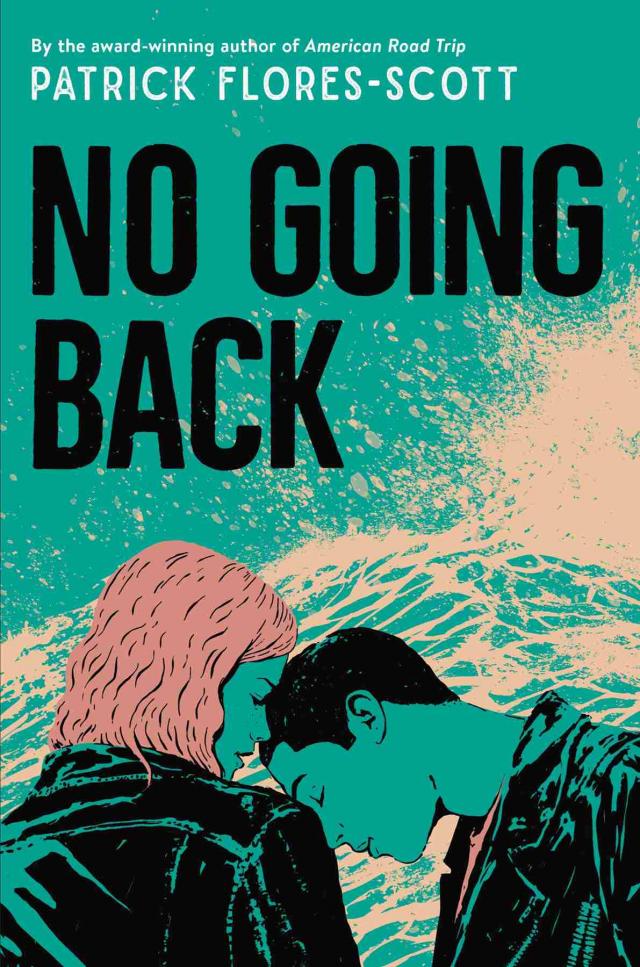
Cover art copyright © 2024 by Adams Carvalho. Cover design by Karina Granda.
Cover copyright © 2024 by Hachette Book Group, Inc.
Heron art: © Vitaly Ilyasov/Shutterstock.com. Background textures: © thongyhod/Shutterstock.com and Speranto/Shutterstock.com.
Interior design by Michelle Gengaro.
Hachette Book Group supports the right to free expression and the value of copyright. The purpose of copyright is to encourage writers and artists to produce the creative works that enrich our culture.
The scanning, uploading, and distribution of this book without permission is a theft of the author’s intellectual property. If you would like permission to use material from the book (other than for review purposes), please contact permissions@hbgusa.com. Thank you for your support of the author’s rights.
Christy Ottaviano Books
Hachette Book Group
1290 Avenue of the Americas, New York, NY 10104
Visit us at LBYR.com
First Edition: April 2024
Christy Ottaviano Books is an imprint of Little, Brown and Company. The Christy Ottaviano Books name and logo are trademarks of Hachette Book Group, Inc.
The publisher is not responsible for websites (or their content) that are not owned by the publisher.
Little, Brown and Company books may be purchased in bulk for business, educational, or promotional use. For information, please contact your local bookseller or the Hachette Book Group Special Markets Department at special.markets@hbgusa.com.
Library of Congress Cataloging-in-Publication Data
Names: Flores-Scott, Patrick, author.
Title: No going back / Patrick Flores-Scott.
Description: First edition. | New York : Little, Brown and Company, 2024. | Audience: Ages 14–18. | Summary: Told over the course of forty-eight hours, seventeen-year-old Tony heads back to his old life in Des Moines, Washington, after being released from a youth detention center, but toxic old relationships and unforeseen challenges make staying on the straight-and-narrow nearly impossible.
Identifiers: LCCN 2023022625 | ISBN 9780316407502 (hardcover) | ISBN 9780316407700 (ebook)
Subjects: CYAC: Interpersonal relations—Fiction. | Family life—Fiction. | Parole—Fiction. | Racially mixed people—Fiction. | LCGFT: Novels.
Classification: LCC PZ7.F33435 No 2024 | DDC [Fic]—dc23
LC record available at https://lccn.loc.gov/2023022625
ISBNs: 978-0-316-40750-2 (hardcover), 978-0-316-40770-0 (ebook)
E3-20240222-JV-NF-ORI
Contents
Cover
Title Page
Copyright
Dedication
Prologue (Dear Reader)
Friday Friday 9:30 AM
When We Were a Team
When I First Started Waiting for Maya
Friday 9:40 AM
When He Was a Hero
Friday 9:45 AM
Friday 10:40 AM
When We Discovered Where the Magic Was
Friday 10:43 AM
Friday 11:37 AM
When the Sofa Became Her Home
Friday 12:25 PM
Friday 1:05 PM
When We Chose to Go It Alone
Friday 1:10 PM
When the Seams Burst
Friday 1:35 PM
Friday 8:20 PM
When We Held Hands, the Sand Came Alive
Friday 9:45 PM
When Maya and Me Met a Dreamer
Friday 9:52 PM
Friday 10:52 PM
Friday 11:18 PM
When We Rescued Gary Jr.
Friday 11:55 PM
Saturday Saturday 8:25 AM
Saturday 9:52 AM
When the End of Us Came, It Sounded like Pounding
Saturday 12:10 PM
Saturday 10:00 PM
When, Wrapped Up in Each Other, We Did Not Kiss
Saturday 11:08 PM
When Looking in His Eyes, I Saw the Worst I Was
Saturday 11:43 PM
Sunday Sunday 12:50 AM
When Mixing Fireworks and Wine, We Laughed
Sunday 8:22 AM
When We Knew What Was Stupid
Sunday 8:50 AM
Sunday 9:30 AM
When Hoping It Meant Something Big, I Worried That It Didn’t
Sunday 11:33 AM
Sunday 12:10 PM
When Waking Up Drunk, We Imagined a Future
Sunday 12:50 PM
When I Tried So Hard to Be Good
Sunday 2:00 PM
When, in Drunken Desperation, I Ran to My Mom
Sunday 2:25 PM
When She Would Not Take Me In
Sunday 3:35 PM
Sunday 4:35 PM
Sunday 4:45 PM
When I Thought There Was No One Else
Sunday 6:30 PM
Sunday 6:50 PM
When I Finally Turned to Grace
Sunday 8:10 PM
Sunday 10:36 PM
Sunday 11:14 PM
Monday Monday 12:23 AM
When I Got a Life
Monday 1:15 AM
Monday 3:10 AM
Monday 4:05 AM
When I Promised to Change
Monday 5:05 AM
Monday 5:55 AM
Monday 6:30 AM
Monday 6:45 AM
When a Period of Waiting Finally Ended and Another One Just Got Started
Monday 6:52 AM
When I Learned How to Breathe
Monday 6:59 AM
Monday 7:02 AM
Acknowledgments
Discover More
Author’s Note
About the Author
In memory of Peg Phillips for bringing theater to incarcerated kids at Echo Glen Children’s Center.
And to all the kids who bravely stepped onto the stage and gave it a try.
Explore book giveaways, sneak peeks, deals, and more.
Tap here to learn more.
Dear Reader,
Have you ever been stuck in a situation where someone with power over your future is judging you?
They’re shaking their head at you, tsk-tsking you, and you can just tell they’re thinking, “I will never understand people like you. But I know your type well enough to know that you are up to no good.”
If the person judging you is capable of thinking those two opposite ideas at the same time—and they’re in control of your destiny—you are very likely screwed.
So what do you do?
My first instinct is to run. But the last time I found myself at the mercy of judgers, I was stuck in a high school conference room with family, my guidance counselor, the assistant principal, and my parole officer. There was nowhere to run, nowhere to hide.
So I closed my eyes, took a deep breath, and said, I know this looks really bad, but…
And I didn’t stop talking until I’d told my whole honest-to-God true tale of the seventy-two hours after my release from Zephyr Woods Youth Detention Center—the good, the bad, the ugly… including the improbable and gripping encounter with the same stolen money that got me stuck in Zephyr in the first place.
In the conference room that morning, I prayed that my story—the story you will read in this book—would convince all the judgers that the situation wasn’t nearly as bad as it looked and persuade one of them that there was no need to send me back.
As you read my story, you will judge me too. That’s all right. It’s human nature to judge. In judging me, however, please keep these words in mind: On our journey to growing and developing into the ideal whole persons we hope to become, we are all just stumbling forward in the dark, searching to find our way the very best we can.
With gratitude,
Antonio Echeverría Sullivan
FRIDAY 9:30 AM
The soles of my shoes drumroll the floor. My fingers tap-tap the table. My face aches from too much grinning, because finally, finally, the buildup is over and I’m sitting pretty at a conference-room table in A Pod, about to say goodbye to this tiny prison in the forest.
Admin Pod is way nicer than the resident cottages. There’s newish furniture and carpet, some fake flowers in a vase, big windows, some inspirational posters on the wall. But don’t get me wrong, it is still Zephyr Woods Youth Detention Center. Still an institutional facility. Lysol smell. Beige walls. Zappy fluorescent lights. The nonstop muffled sounds of walkie-talkies. The metallic buzzing and clacking of doors locking and unlocking. Sobs from the clinic or angry screams from some terrified kid they’re dragging in on their first day—a new one who hasn’t given up the fight. Prison living—am I right?
Well, the reason I’m bouncing in my seat, not giving a flip about prison living, is because this is my reentry team meeting. That means I AM OUT OF HERE! I am finally leaving this depression factory that has caused me so much loneliness and anxiety.
I smile across the conference table at Mrs. Williams, my counselor, and Ms. Duncan, my English teacher. They’ve been my resource team since I got put in here. And now they are the core of my reentry team. They smile right back like they’re so proud of me.
I turn away and point out the window at the forest, pretending I spot a bald eagle, while I swallow the lump in my throat and close my eyes to keep tears from coming.
Despite the big effort, a couple drop and slide down my cheek.
Mrs. Williams holds out the box of tissues. I yank one and think how far I’ve come since she and Ms. Duncan watched me rage in here like a freaking hurricane.
Truth be told, even before I came into this place I was a soda can full of built-up emotional pressure. Getting hauled into Zephyr just intensified it. The humiliation of handcuffs and shackles. The fear of prison kids and prison guards. The fear of life without my best friend, Maya. The fear of life without freedom. The realization that I would forever be a convicted felon.
It all shook me so hard, I could no longer contain the pressure. I erupted, and my darkness spewed over the land. I screamed. Sobbed. Begged for my mom. I kicked. Flailed. No one would have believed I was capable of that type of nuclear meltdown. I couldn’t believe it either.
At Zephyr it was nothing new. They had the protocol down. Two beefy, bald guards. Snug wraparound jackets. Copious drugs. Independent reflection time in a padded room.
When I finally gave up the fight, Mrs. Williams and Ms. Duncan kicked into gear. I’m happy those two ladies are here to celebrate this moment with me. At the same time, I get a twinge in my gut thinking about the people who can’t be here. Two of them, Charlie and Maureen—the volunteer Alcoholics Anonymous chairpersons—are at their day jobs.
I ended up in AA because, after speaking with people at Puget High School, the court determined I had an issue with alcohol. I knew the I’m not an alcoholic, I just drank too much argument wouldn’t get me anywhere, so when they said I had to enroll in a sober-support class at Zephyr—in my case, AA meetings—I just nodded and kept my mouth shut.
In AA meetings, Charlie and Maureen dug into the twelve steps. We had to admit that we were powerless over alcohol. We were instructed to make a fearless moral inventory, and told we needed to embrace a higher power and to ask our chosen HP to remove our shortcomings.
To be honest, that woo-woo stuff wasn’t for me. In fact, I was just about to tune Charlie and Maureen all the way out, when they started talking about steps eight and nine.
These two steps guide you in making things right with the people you hurt because of your dependence on getting drunk. Everyone wants to live their life as a responsible person. Well, being a responsible person means you have to deal with the consequences of your actions. And that means making things right with the people you hurt.
I still wasn’t sure if I was an alcoholic. But I was fully aware that I had an accountability problem. I blamed others for my hurtful actions. In AA, I realized that in blaming others, I was letting those people define and control me.
I decided I was through playing the blame game. From now on I would take full accountability, full responsibility for what I’d done. I began the process by doing step eight. I made a list of the people I had hurt and wrote down my plan to make amends.
On to step nine. Making amends. In this step you tell the people you hurt that you are sorry. You say exactly what you did, while making zero excuses for your behavior. If you do make excuses or blame others, it will be so obvious that you are not holding yourself accountable for your actions, the person you are apologizing to will just roll their eyes because you don’t even get it.
After the apology, you promise the person that you will do everything you can to make things right. You complete the act of making amends by living your life according to those words. And if you stick to that plan, you just might repair a relationship that you had broken.
My only problem? I couldn’t make amends to the people I hurt until I got out of Zephyr. So I thought about which staff could help me earn my parole ASAP. And I did what they told me to do.
In class, Ms. Duncan told me my life mattered. My experiences and memories mattered. If I could write them down, I could think about where I came from and where I wanted to go. So I started writing my most powerful memories in poems. Poems that tell the story of a great childhood. Poems that explain how it all came crashing down, how I committed my crime, got arrested and locked up in Zephyr Woods.
In counseling, Mrs. Williams told me the dark thoughts stewing and bubbling inside me mattered. If I could get brave and speak them out loud, they could be examined. So I started spilling my guts.
Close your eyes, Mrs. Williams would say.
Inhale deep.
Exhale slow and long.
Repeat until you can look at the thought and ponder it.
What is this thought doing for you? Is it worth holding on to? Is it worth acting upon?
If it is worth acting upon, what course of action will do the least possible harm to yourself or others?
Soon, I began to notice my thoughts outside of counseling. I could stop and breathe through them before my head and hands got tingly and my breaths raced away. And before I reacted in a way I would later regret.
I did all that mental work. And I kept a journal of the actions and attitudes required to impress people enough to earn my parole. Stuff like this:
• When you encounter Zephyr drama, walk the other way fast.
• Every action you take is a CHOICE YOU MAKE. Choose wisely!
• When they ask for volunteers, be the first to raise your hand.
• Listen in class. Ask questions. Do your work. Improve your grades.
• When you need to, do your breathing—try for six deep breaths a minute, like Mrs. Williams taught you. Slow your heart. Get calm. Consider how you will respond to that stimulus you found so aggravating.
• Practice that which you want to do well. (An example of this one is, I found a quiet place to practice the words I plan to say when I make amends to the two people in my life I hurt the worst when I committed the crime that got me shipped away from them when they needed me most—Carmen Echeverría, mom; and Maya Jordan, lifelong best friend.)
The old Antonio would have rolled his eyes at any kid who journaled crap like that. I would have called that kid a tool. Turns out, the old Antonio was the tool, because all the focus and effort led to so much personal growth that I earned my parole after a year and a half. That’s six extra months of living life as a free person!
And it’s the reason I’m not locked up in a sensory-deprivation cottage eating a breakfast that tastes like Styrofoam with a bunch of hormonal, depressed, sweaty, overmedicated juvenile offenders. Instead, I’m sitting here with Mrs. Williams and Ms. Duncan, staring at the conference-room door, awaiting the arrival of my parole officer and my mom, and counting the minutes until I get out and I can see Maya again.
When We Were a Team
Once upon a time, on a wet spring day in first grade,
my mom asked me to join her
at the Waterfront Farmers Market.
In matching raincoats and fingerless wool gloves,
we stood behind a table
and sold her coveted salmon-themed mugs.
Sockeyes, Cohos, Chinooks.
I’d wrap the mugs tight in paper and
hand them over to a delighted buyer
while she offered informational tidbits
about the life of our region’s most sacred fish.
As each customer walked away,
she’d smile and hoot, ¡Otra venta!
She’d raise her palm high. Gimme five!
I’d jump up and give it, then pump a fist.
We did it!
• • •
In her studio, together on the stool,
she’d wrap her arms around me,
cup my bare hands in her clay-smeared hands,
then set the wheel to spinning,
singing me songs she learned as a kid back home.
A mi lechero no le gusta la leche—
¡Pero quiere que lo tome yo!
She’d sing and sing as we pushed and pressed that
cold, wet blob till I thought it was done.
¡Ya Mamá!
She’d scrape my creation off the wheel,
lift it high, and call it beautiful.
Then she’d set it to dry and fire up the kiln,
treating my mess like a work of art.