The montforts, p.1
The Montforts, page 1


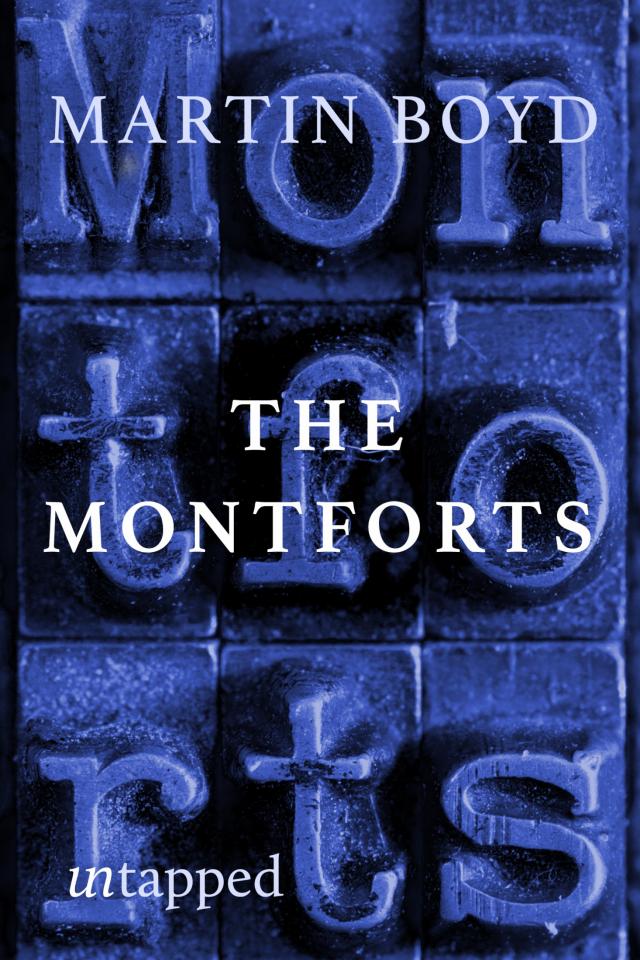
MARTIN BOYD
THE MONTFORTS
About Untapped
Most Australian books ever written have fallen out of print and become unavailable for purchase or loan from libraries. This includes important local and national histories, biographies and memoirs, beloved children’s titles, and even winners of glittering literary prizes such as the Miles Franklin Literary Award.
Supported by funding from state and territory libraries, philanthropists and the Australian Research Council, Untapped is identifying Australia’s culturally important lost books, digitising them, and promoting them to new generations of readers. As well as providing access to lost books and a new source of revenue for their writers, the Untapped collaboration is supporting new research into the economic value of authors’ reversion rights and book promotion by libraries, and the relationship between library lending and digital book sales. The results will feed into public policy discussions about how we can better support Australian authors, readers and culture.
See untapped.org.au for more information, including a full list of project partners and rediscovered books.
Readers are reminded that these books are products of their time. Some may contain language or reflect views that might now be found offensive or inappropriate.
Introduction
When The Montforts was published in 1928, it was written under the name of ‘Martin Mills’. This author was then little known in England, where he had published two novels, and scarcely at all in Australia. The Montforts was his first success; reviewers in both countries praised the wit and economy of its prose, and the skill with which it presented an intricate family history against the background of early Melbourne. The novel won the Australian Literature Society’s first gold medal; and it was one of the ironies of its unexpected success that it was out of print before the medal could be awarded. It was the end of ‘Martin Mills’ for when The Montforts made his reputation it took away his pseudonym, and he became Martin Boyd. For the rest of his long life (1893-1972) the author of Lucinda Brayford and the ‘Langton’ novels wrote under his own name.
The material of The Montforts was drawn from the history of Boyd’s family in Victoria; although it is fiction it includes some thinly-disguised portraits from life. Martin Boyd belonged to a family, distinguished in Australian life from the early days of the colony, which kept unbroken its links with England. His great-grandfather, Sir William à Beckett was the first Chief Justice of Victoria. When Sir William’s grand-daughter, Emma à Beckett, married Arthur Merric Boyd it was the beginning of a family tradition in the arts which flourishes today. Emma and Arthur Boyd were painters, and their creative talent was inherited by their sons, Merric, the sculptor and potter, Penleigh, the painter, and Martin, the novelist. The next generation also produced work of great distinction in the painting of Arthur and David Boyd, the sculpture of Guy Boyd, and the architectural designs and writings of Robin Boyd. This family, with a strong sense of its identity and its history, was an asset to a writer of Martin Boyd’s talent; it helped to develop his awareness of the past as a shaping force in human destinies and gave him a framework and perspective for fiction. The Montforts is the first of a series of Anglo-Australian chronicles in which Boyd records the experience of the short-lived colonial aristocracy of early Melbourne, from the gold-rush period to the end of the First World War. As social history, these novels deserve attention, but their real concerns are the complex relationships between patriotism and civilisation, art and religion, the individual and his past.
In The Montforts the central interest is in what Boyd called ‘the past within us’. Each member of the Montfort family is shown in the light of his human inheritance. The pace is brisk: ‘Captain Wynch caught a chill out hunting, which he neglected, and died of pneumonia.’ With so many characters and a time-span of five generations, the novel risks being overcrowded, but on the whole Boyd selects skilfully the incident or scrap of dialogue which reveals without need of commentary the essentials of character.
In 1963 Boyd revised The Montforts for the edition which is reprinted here. He said the book needed trimming, but a comparison of the two versions shows that, while he trimmed some pages, he added others. He changed the names of a few characters, added some minor figures, and pruned some untidy prose. His most interesting changes affect the characterisation and the social comment: of these, a few examples may be given. In the 1928 version, Sir Henry Montfort is sketchily drawn. The revision gives him a mistress, an illegitimate son, and a sense of community with fallen man—a religious sense which links him with the eccentric piety of Sophie Jane and the fierce puritanism of Jackie. The encounter between Harry Montfort and his father’s former mistress, Hetty Trevor, is a new episode; so is Sophie’s escapade with Mr Moffat. The latter seems intended to make less abrupt Sophie’s turning from worldly to religious preoccupations. Boyd also resolves the ambiguity of Richard Montfort’s love for his cousin Aïda; a few changes limit the reader’s sympathy. There is a reference to Richard’s ‘negative fidelity’; and his concern to be ‘honourable’ becomes his wish to be ‘proper’.
Raoul Blair, the central character of Book III, is to some extent a self-portrait; as in all Boyd’s novels, fact and fiction are blended here. A sentimental account of Raoul’s schooldays at St Saviour’s (based on Martin Boyd’s years at Trinity Grammar School) is discarded. It is a pity that Boyd also deleted two episodes which help to explain the attitude of Raoul to his brother Jackie: an attitude fearful yet protective, alternating between sympathy and revulsion. Here is one of the episodes:
‘… once on a hot day, when Raoul announced that he was going indoors for a drink, [Jackie] took him instead into a parched, shadeless paddock and tied him up there for forty minutes, saying that Christ had endured the torments of thirst for forty days, compared with which Raoul’s sufferings were as nothing.’
Another omission, easier to justify, is that of most of Raoul’s poems; three immature sonnets (two of which Boyd had published under his own name in 1920) have disappeared. And, just as some of the characters are altered, so, too, there are changes in the authorial voice. The Martin Boyd of 1963 distances himself from Raoul’s qualified optimism about Australia’s future. The tirades against materialism and mediocrity added to Book III come from a minor character, but the voice is that of the older Boyd, disillusioned by his return to Australia in middle life.
The version of The Montforts presented here is the one Boyd wished his readers to have. No one will blame him for suppressing his early poems and some purple prose; and his second look at Australian society gives the revised novel an interesting double perspective—that of Boyd with bifocals, perhaps. Those who want to trace the novelist’s development from The Montforts to Lucinda Brayford and the ‘Langton’ novels will need to look at both versions, and for this reason the existence of the earlier text should be remembered while the present one is read with the attention and pleasure it deserves.
Brenda Niall
Monash University.
Prologue
‘Et honestas miserias accusant.’
The motion of the ship gave rise not only to physical discomfort but to mental apprehension. When her bow plunged down over huge successive waves, her stern hung in the air, and Henry Montfort’s rather unwieldy bulk gave a short, uncomfortable slide towards the head of his berth. He wondered how his wife in the bunk below was enduring this privation, and raised himself on one elbow to look down at her. She heard him move.
‘Are you comfortable, my dear?’ she asked.
‘I was about to ask you that question,’ he replied.
‘I find it a little difficult to sleep.’
‘This pitching motion is very disconcerting. I shall be relieved when we are free of “Biscay’s sleepless bay.”’
He sank back on to his hard pillow. He was too big to lie comfortably on either side, so he lay on his back and stared up at the narrow varnished boards, eighteen inches above his head. The light of a swinging lamp, turned low, made dim uncouth shadows in the cabin, which was stuffy but cold. The lamp squeaked on its hook, the woodwork of the ship creaked, and from above came the incessant thud and splash of water. In former days, watching from the shore the placid surface of the Channel, he had never imagined this vastness of water. Now, churned into great waves, stretching for miles on either side of him, flung in spray above him, and with immeasurable depths below him, the ocean seemed indicative of the majesty of God, and of the insignificance of man, who floated even in these fine ships of seven hundred tons, a mere speck in creation.
And yet man was undoubtedly ‘the noblest work of God.’ Compared only with the might of Jehovah himself, was he insignificant. His power to master the elements and unveil the mysteries of science daily increased. This was a remarkable century in which they lived. It was not so long since the Queen had made her first famous journey in a carriage drawn by a steam-propelled vehicle, and now trains as a means of transport no longer excited great attention. And did not that Queen rule over increasingly wide dominions, new countries, to one of which he was now migrating with his wife, his children, his servants, his lares et penates? His lips were compressed at the thought of the responsibility which, by this decisive move, he had incurred towards his family, and lines of anxiety puckered his forehead, which was broad immediately above the eyes but inclined to narrow toward the top of his head.
Yet Simon repeatedly had written, urging him to come, and painting attractive pictures of life in the Colony of Port Phillip, mentioning the admirable climate, the horses, the spaciousness of life, and, above all, ‘the opportunity for simultaneous personal advancement and the service of the State.’
Under the buffet of a more violent wave the ship stopped and quivered like a smitten animal. From above came the sinister sound of flapping canvas. The thought of Simon’s letter was jolted from his mind. Letitia gave an involuntary cry.
‘There is no danger, Letty,’ he said with stern kindliness. ‘The Captain told me this evening that he has weathered worse storms than this.’
‘I must go to the children,’ she said, nervously raising herself and clinging to one of the upright supports of the berths.
‘No, no. I shall go, my dear. Stay where you are.’
He sat up and bumped his head on the ceiling, to the closeness of which he was not yet accustomed. He suppressed a ‘damn,’ and, for decency’s sake gathering his nightshirt about his knees, he climbed awkwardly down to the floor where he stood for a moment, pontifical and shivering.
With difficulty, due to the motion of the ship, he struggled into a greatcoat of blue cloth and lurched out into the corridor. He knocked softly on the door of the next cabin, to warn the nurse of his approach.
In the dim light he could see the fair heads of Arthur and Amy, asleep on their pillows, while from where the tangled head of the nurse showed above the blankets, came cheerful indifferent snores. Harry, his eldest boy, slept in a hammock in another cabin, attended by Gray, the butler. Henry did not bother to look in on them. He frowned and returned to his cabin.
‘They are sleeping peacefully,’ he said. ‘Martha is snoring,’ he added, as he climbed back to his berth.
While he regarded the nurse’s conduct as an example of the insensibility of the lower orders, he was pleased that his children should be unconscious of peril. It seemed a proof of their fitness to be adventurous colonists, truly English, the successors of Raleigh and Drake and Captain Cook.
He lay a moment thinking of these heroes. He and his family travelled in a great modern ship, over charted seas, to a known and, from all accounts, desirable country. They had gone in small vessels, and discovered these new lands which were now the fit abodes of white men. And yet he considered that he had undertaken an adventure, and shown some courage. The courage of men who had gone out in those tiny vessels seemed incredible to him. Beyond facing the inevitable risk undertaken by all travellers, he had shown no physical courage. His mind lingered round the idea of courage. After ten minutes he decided that courage was the endurance of suffering, or the undertaking of risk, for the attainment of a reasonable objective—anything beyond that was foolhardy. He was fond of definition.
For months before he had made up his mind to leave England, he had gone into every possible argument for and against this decision, but now, lying sleepless in the stuffy cabin of this trembling, battling ship, he reviewed them again, and it seemed possible that he had laid himself open to the charge of foolhardiness. Had he been right to take his children from their own country, from every association of their race and ancestry? He had not fully realized what leaving England would mean, until he had seen her green fields becoming dim beyond Channel spray. And now he might never see those fields again. His children, during their childhood, certainly would not see them. They would have to learn the names of new field-flowers, to play under hot dry trees. The very birds and animals would be different, though Simon had mentioned that rabbits were being introduced into Australia, as were also foxes for hunting. The thought of Simon’s letters was heartening. But if his migration were unfortunate, he would not shift the responsibility on to Simon. He would face the consequences of his own action.
His mind strayed to his Somersetshire home, the house and village with which his family’s history and fortune had been so inextricably bound that it seemed scarcely possible one should exist without the other. For six centuries they had been there, ever since Raoul de Montfort, a cousin of the illustrious Simon, had deserted to Prince Edward’s army before the battle of Evesham, and so not only had escaped the slaughter which encompassed Earl Simon’s frail army, but had been rewarded with the manor of Farleigh-Scudamore. There, ever since, his descendants had lived, during the Middle Ages small squires, and at times little more than yeomen, preserved by their remoteness and insignificance.
Under the Tudors they had reasserted their gentility and right to coat-armour. Simon in 1563 had enlarged the manor-house, though not to any great size, and restored his name, which had degenerated to Munford, to Montfort. He had also annexed the Chapel of the Virgin in the parish church as a burial place for his family, and there was his monument, with a neat descending row of eight children. After another century and a half of marriages with the daughters of neighbouring squires and parsons, Raoul, at the end of the seventeenth century, built a classical façade and porch to the house and prefixed his name with ‘de.’
Simon, his son, took holy orders. Being sent by his father on the grand tour, as bear-leader to the son of a duke, he met, fell passionately in love with and seduced a Mademoiselle Madeleine du Rémy des Baux. Tormented in conscience, he begged her to marry him, at which she was amused. It was not convenable for the daughter of a Rémy des Baux to marry a Protestant clergyman. Monsieur le Marquis would be furious at the very suggestion. He would have to fight a duel, and as he was a clergyman he couldn’t fight a duel, and there would be no end of trouble. Disconsolately he continued his travels, but they met in Paris six months later. She was going to have a child, and decided that it would be more convenient to be married. Simon left the duke’s son and fled with Mademoiselle to Calais, and eventually brought her to Farleigh-Scudamore, and to his father’s astonished fury.
But the man who attached value to the ‘de’ before his name was not insensible to the merit of one which contained both a ‘du’ and a ‘des.’ Also, his son’s lapse was in the family tradition, as the great Earl Simon had married Eleanor Plantagenet, in spite of that lady’s being a nun. So Henry Montfort’s grandparents were married in time to secure his father’s legitimacy. Madeleine de Montfort bore another child, a daughter, after which she tired of life in a small country manor-house and eloped with a cavalry officer named Hughes, whom she left to become the mistress of a peer.
Raoul, her son, grew up more filled with shame for his mother’s lightness, than pride in the distinction of her antecedents. His father fed this sense of shame. Her name was never mentioned. All trace of her occupation was removed from the house. He even dropped the ‘de’ which his father had assumed, as suggestive of something foreign and wanton. He treated his son sternly, regarding him more or less as the fruit of sin, especially as the boy had his mother’s slanting eyes, sensitive amused mouth, and sharp wit which was always reproved with the rod. He felt it his duty to tell him, at the age of eighteen, of the circumstances of his birth, relishing his own humiliation as an atonement, and giving the final twist to a nature already warped by a sense of inferiority.
Raoul felt that he might as well be illegitimate, and after that his soul was engaged in a quivering warfare with all that part of the human race which stood for justice rather than mercy, and for order rather than individual happiness. He could not bear to stay in Somerset, where he felt that his shame must be widely known, and went to live in London. He engaged in various political activities, which his father considered disreputable and blasphemous. They mostly took the form of an attempt to ameliorate the lot of those who were desolate and oppressed. On his father’s death he inherited the estate, but he continued to live in London, where he married, partly from compassion, Mary Steele, the daughter of an unsuccessful attorney.
When he had children, he once more opened Farleigh-Scudamore House, and the children lived there with their mother and, later, when the boys came to London to go to Westminster School, returned there for the holidays.
It was to these days that Henry Montfort’s mind returned as he lay sleepless on his hard narrow bunk. He remembered one December morning waking early in the house in Cork Street. It was the first day of the holidays and he, and Raoul and Simon, his brothers, had celebrated the occasion with a pillow fight. Their father had come up and shouted at them to stop. Raoul had poked fun at him. There had been a duel of wits. Young Raoul won, and their father had gone off, crestfallen and grumbling, in nightcap and dressing-gown, looking, so Henry thought in later years, like a drawing by ‘Phiz.’