

Carnival of the mind, p.1
Carnival of the Mind, page 1
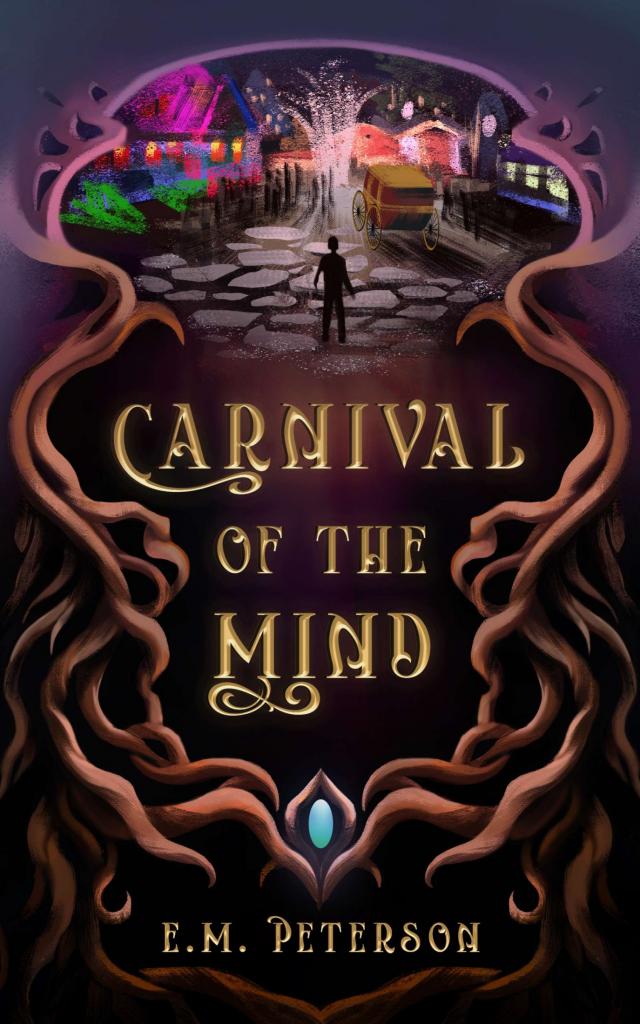


Carnival of the Mind
E.M. Peterson
Copyright © 2023 by Ethan Peterson-New
Cover copyright © 2023 by Casey Gerber Creative
All rights reserved.
No portion of this book may be reproduced in any form without written permission from the publisher or author, except as permitted by U.S. copyright law.
The Wasteland
First I am nowhere, then I am here.
I’m sprawled on top of sand. In fact, I’m not so much on it, as slightly in it. As I pull my arms free, grains stream off me, forming into miniature ridges, topographies that swirl of their own accord. I come to a sitting position and look out over a barren expanse. Rolling dunes spread before me, broken only occasionally by clusters of spiky succulents. It must be day because the sun is beating on my neck, yet the murky quality of the light makes the landscape feel twilit. The sky is close with muddy clouds. Nothing stirs below.
I grasp for any recollection, but the space on the other end of consciousness, the space where memory should be, is a yawning nothingness that resists my efforts to fill it.
The dry pain in my throat is what ultimately brings me to my feet. I put aside the larger, more difficult questions, and focus instead on my need for water.
A dull yet persistent rumble—the only sound I can hear—pulls me forward. Maybe at the other end of that noise is a gorge containing a rushing river. I walk toward it, sand sifting between my toes. Why the hell am I barefoot?
As I crest each dune, I stop to catch my breath, looking out for a glimpse of water or civilization. But nothing has changed. The dunes continue in their rolling patterns, and there’s nothing but randomness to the growth of the cactuses.
The sound grows closer though. Eventually it becomes so loud that I think the body of water making it might be the ocean rather than a river.
As I stumble into the deepest valley yet, the noise of water becomes a solid wall. I look up and see a roiling wave pass over the top of the dune above me. I turn to run. As I do, my attention catches on a beeping plastic object around my wrist. I just have time to see that the tiny LED screen counts upward with every chaotic step before the water is upon me.
My arms churn wildly against the force of the wave as I’m carried up the ridge. Soon the water is so deep that the desert’s previous shape is lost completely beneath the waves. The water has a hold of me, and anything I do makes little difference. Huge waves bounce me up and down like a human cork. My only focus is keeping my mouth high enough to choke down breaths.
At the top of one wave, I can see for miles, and the effect is no less startling than the emptiness of the previous landscape. The former desert is now a single green ocean, with the high waves of a stormy sea moving over it.
No cactuses, though.
I realize with morbid satisfaction that the water streaming into my nose and mouth isn’t saltwater. At least I won’t be thirsty while I drown. I gulp greedily, choking a few times when water gets shoved down the wrong pipe. The water may not be salty, but it’s not entirely fresh, either. It tastes almost sweet, like sap freshly drawn from a sugar maple.
My legs are already tired. My arms burn from the effort of keeping my head above water. There’s no sign of a break in the waves. Even if I were in control of my direction, as far as I can tell there’s nothing to swim to. My only choice is to keep afloat. The current is taking me the direction I decide to think of as east, opposite the sun, which hasn’t moved since I awoke.
My conception of time is surely skewed, but it can’t be more than a few minutes of treading water before I spot a break. Not a surface exactly. My eyes lose it as I’m swept down the leeward side of a wave, but it’s still there when I crest again. Something—a skin of algae, possibly a school of fish—appears to be growing on the surface. I swim toward it frantically, hoping it can hold my weight and allow me to rest for a few minutes. Every time I look up, the patch has grown, until it covers close to three-hundred square feet of ocean. As I thrash toward it, I’m suddenly aware of the water resisting. Soon my arms can’t even break the surface. I pull myself up onto the soft, porous surface, and lie on my back, exhausted.
Water splashes through the buoyant substance that is supporting me, but it holds me a couple inches in the air. There’s nothing particularly organic about the brown mass under me, and yet it’s replicated so rapidly that I can no longer see a single unoccupied patch of ocean.
I think vaguely that I should be worried about this being some hostile life form that will consume me as it continues to clone itself. I reach down, trying to get a better grasp of what exactly it’s made of. It’s coarse, and comes away between my fingers, resolving into dark clumps of…
Is that sand?
The sea has slowed its rocking as the sandy substrate on top of it counteracts its natural motion. Then the world stops moving completely and I’m thrown off balance.
I’m once again on a bed of sand, dunes rambling far into the distance. A few cactuses have begun to grow again from the top of the dunes. Something is deeply wrong with this place.
With my thirst quenched and my limbs exhausted, it seems pointless to move just yet. Sand cakes my entire body. The device on my wrist displays the number 973. I tug at its elastic band, grating sand into my arm. I pull harder, trying to find any seam. But there is no discernible way to remove the device. I give up, wishing the water had destroyed it.
I rub the sand from my hands and wipe my face. My fingers expect to find the faint divot of acne scars—lower on the right side so that if you’re close enough to notice them, I begin to look a touch lopsided—but there’s nothing but smoothness there. My chin feels weird too, in that there is just slightly too much of it. The long, thin limbs splayed out in skinny jeans and a plain gray T-shirt are definitely my own, but are missing several of my less prominent freckles. On the upside, the hair on my toes is missing, giving the clusters of drying sand less to grab onto.
As much of a leap as it is, I begin to consider my location no longer merely a question of geography, but possibly one of astronomy. Maybe I’m an interstellar traveler who frequents planets millions of light years apart, and my amnesia is merely a symptom of a particularly rough jump between different points in space-time?
I think if I was something that cool I would remember it. Besides, where’s my damn spaceship?
Over the next few hours, the landscape’s cycle repeats three more times. A roaring wave rises over the dunes, engulfing the desert with seawater. Then the landscape settles, the waves’ crests becoming the crests of dunes.
I notice a few things I couldn’t before, when I was distracted by the whole “trying not to drown” thing. First, the water changes each time, both in color and in flavor. The following wave is too salty to drink, while the next is yellow in color but—thankfully—tastes of pure spring water. Second, the water always flows in the same direction, away from the sun, which I can now confirm has not seen fit to rise or set a single degree since I’ve been here. And third, the dry part of the cycle is about five times as long as the aquatic one.
My thoughts turn toward food. I try extracting the meat from one of the cactuses. As I place my hand between the spikes, the cactus squirms. I nearly cut myself pulling away. But looking closer, the movement was not in response to my touch. The entire trunk is moving upwards in a swirl of morphing flesh. The cactus is growing before my eyes.
“I really wouldn’t touch that if I were you,” comes a voice from behind me. I jump so violently that I almost cut myself again on the cactus. A young woman sits at the top of the next dune, watching me. She stubs out a cigarette on the sand. One side of her head is buzzed, and the rest of her chin-length hair falls in a manicured arc over the buzzed area. Though I can’t see any tattoos on her arms, she gives the impression of having at least three or four.
“You have a name?” the young woman says, seeing that I’m too surprised for an intelligible response.
“Matthew.” Got that at least. My voice feels like it’s rattling through a rusty tube. “And you are?”
“June. Good to meet you, Matt.”
“Matthew’s fine.”
“Whatever you say, Matty.”
June gets up. She’s about my height and probably a year or two older than me, likely in the first couple years of college. The thought of college fills me with a combination of excitement and dread.
“Do you know where we are?” I try.
“Yes,” June says. “That’s why I’m going to take you somewhere much better.” She looks at the dull sky and kicks the sand disdainfully.
She turns and walks directly toward the sun, and I realize I have nothing to do but follow. She takes strides that are considerably longer than her legs should allow, forcing me to maintain the awkward middle ground between a walk and a trot to keep up.
“So you know the way out of here?” I say.
“Out of here and all the way to the Carnival,” she replies without turning around. “But of course, you don’t know anything about the Carnival.” She gives me a shrewd look. “In fact, you don’t seem to know much about anything, do you?”
Though technically true, I’m not about to agree. “What is the Carnival?”
“The Carnival’s where we’re going. It’s my home, and not at all like the Wasteland. Trust me, there’s nothing to worry about there. The Carnival’s about as close to non-stop excitement as you can get without actually forming your own cult.”
“You don’t make it sound li
“It’s all real,” June responds. “Though place is probably not the right word.”
A couple minutes later, a wave crashes over the top of the next dune. Once again I am swimming, doing my best not to fall too far behind with the water’s flow. I look up between strands of hair that have fallen in my eyes, and see June sitting gently on the surface.
“You’re a pretty good swimmer,” she says.
“Not any better than you, apparently.” My words are interrupted by the occasional splash of lemon-flavored water in my mouth.
“I’ve never really been into swimming while wearing shoes, they always take forever to dry out.” She indicates her black combat boots, which are folded under her crossed legs and, though touching the top of the water, are completely dry.
While we wait for the water to re-solidify into sand, I ask June if there’s a trick to not having to swim. She replies that of course there is. When the waves disappear, we’re walking again, the sand grating beneath my wet feet. June offers me shoes, but I turn them down, knowing I might need to do more swimming. I wonder where she would even be keeping shoes, as she doesn’t have a bag with her.
Hours pass, but night never falls in the Wasteland. We continue toward the sun, halted periodically by the rhythmic return of water. There is no change in the land itself, but the sun grows larger with each passing hour until it takes up a good third of the sky.
“It’s not really the sun,” June says in response to my confusion. “Think of it more like a heat bulb. It gives off light and enough heat to keep the Wasteland a reasonable temperature. Now that I think about it, that’s basically what the sun does. That’s a head-scratcher for sure.”
“So we’re going to, what, pass the sun on our way?”
“Pretty much. Although you’ve also gotta pass through the Substratum to get to the Carnival.” June sighs. “More boringness to get through, sadly.”
“Sorry me being unwillingly deposited in a barren desert/ocean is so uninteresting to you.”
“It’s okay, it’s not like I was busy negotiating a peace treaty between the Armageddeons and the Apocalyptians or anything.”
“The Armaged—”
“Those guys will simply not stop fighting.”
June springs over a small cactus, her boots grazing the uppermost needles. I skirt around it. I don’t want to hear about the Armageddeons. I just want to know what’s going on. And then leave.
The device on my wrist buzzes as June picks up her pace, as if goading me on.
“That’s all fine, but where the hell are we?”
“The Wasteland.” June puts up a hand, anticipating my response. “I know that’s not what you’re really asking. But you have to understand this place before you can define it. Anything else would be unsafe.”
“Unsafe?”
“You’re not a stable entity, at least not yet. You could do a lot of damage both to yourself and to the people around you.” She gives me a pointed look.
As we rise over the next dune, I see the first change in the landscape. Beneath the bottom curve of the massive sun runs a range of mountains. They rise in square, uniform peaks. From this distance they look like they’ve been carved out of bedrock by an obsessive god. Our pace quickens with our destination in sight, and we only have to deal with one more flood before we reach the base. This time I note that the floodwater comes from the top of the mountains, pouring down in an orange cascade.
We reach the mountains just as I’m starting to dry. I look doubtfully up, half expecting another wave to crash down from overhead. June leads us quickly up the rectangular steps carved into the solid rock. As we climb, it becomes apparent that the squareness of the mountains themselves informs the composition of everything within them. All squares and rectangles, perfect edges form steps, columns, and cliff-faces.
June turns to me as we begin our ascent. “Welcome to the Substratum.”
The Substratum
There are no railings in the Substratum. It’s hard to notice much else as I narrowly avoid falling hundreds of feet off the staircase into the chiseled ravine below. June keeps a quick pace, taking two steps at a time. I take June up on her offer of shoes, and she produces a pair of neon green running shoes from a beat-up tote bag, saying, “They have incredible arch support.” They fit. I try to focus on how strange it is that June knew my shoe size and that she suddenly has a tote bag, rather than on the drop next to me.
While the Wasteland was silent except for the cyclical roar of water, the quiet in the Substratum beats on me. Sound echoes off the rock, but in a cold, dead voice, as if the sound itself has been stripped of its life. Even June—who navigates effortlessly around bends, between forking pathways, and up stairs that become so tall that we have to scramble up them—seems uncomfortable here.
As we climb further, all of the questions I want to ask June bubble toward the surface. I start to ask how she knew where to find me, but she shushes me. Even that sound echoes off the gray rock, before being swallowed by the chasm.
She steps close and whispers, “Your voice is vulnerable here. Speak too loud, and it might become a permanent part of the Substratum.”
I imagine the voice being ripped from my throat, condensing down to the size of a stone and melting into the surrounding rock. I keep my mouth shut.
At the top of a steep rise, we come to the entrance of a cave. The trail winds its way through the cavern, but June pulls me up short. Our voices remain at a whisper.
“I should warn you, this place is disturbing,” she says. I study her face, but nothing in her expression indicates anything besides sincerity. “It’s really the only way through, though. If you want you can close your eyes and I can lead you, but to me that sounds scarier.”
“I’ll keep my eyes open,” I say, partially because I do think it would be scarier, and partially because I’m internally screaming at the thought of being led by the hand like a child. “What makes it so disturbing?”
“The rest of the Substratum is constructed, it’s built from the ground up. It’s all intentional, which at least means it’s controlled. The things we’re about to see in that cave are not constructed. They’re much older than the rest of this place. Even older than the Wasteland or the Carnival. It’s a wilder, more primal place.”
After the rigid order of the mountain, the jagged walls inside throw me off. We follow a worn but uneven trail inward. Though no source is visible, there’s plenty of light to see by, even after we’ve passed out of sight of the entrance. June leads more slowly.
The first indication of anything wrong is a low growling that makes the hairs on the back of my neck stand on end. It grows louder and more bloodthirsty as we continue, until it consumes the whole cave. I want to run, I want to leave this place and get away from whatever is making the sound. We press on. As quickly as it had come, the growling stops. Silence. Save for our echoing footsteps.
A shape catches my eye to one side. I flinch before I see that the shape is not in front of the rock. It’s part of it. Buried in the rock wall but still eerily visible is the outline of a wolf, its mouth locked in a distorted snarl.
The wall on the other side holds the stretched image of a baby, its limbs horribly bent, its mouth open in a cry. The horror is overwhelming.
“Keep moving,” June says.
Images become more frequent along the walls. Trees, other green things, a naked woman and man, with their arms stretched downward so we have to walk below them. More sounds arise, deep sounds, ones I can recognize without naming. The wail of an injured child, the rumble of a storm moving up a valley, the sprinkle of rain in trees. With it comes the unmistakable scent of ozone, that questioning smell that precedes a coming shower.
It’s not all frightening, but a lot of it is. Most of the images, sounds, and smells raise instinctive fear. At one point smoke rises before us, and we have to put our shirts over our mouths to keep from choking. My heart pounds in my ears, and I can feel myself sucking involuntarily at the smoke-clogged air through my shirt. My eyes water horribly as my visibility is cut to just a few feet. June shows no sign of panic as she leads me forward.






