

The wagoner, p.1
The Wagoner, page 1


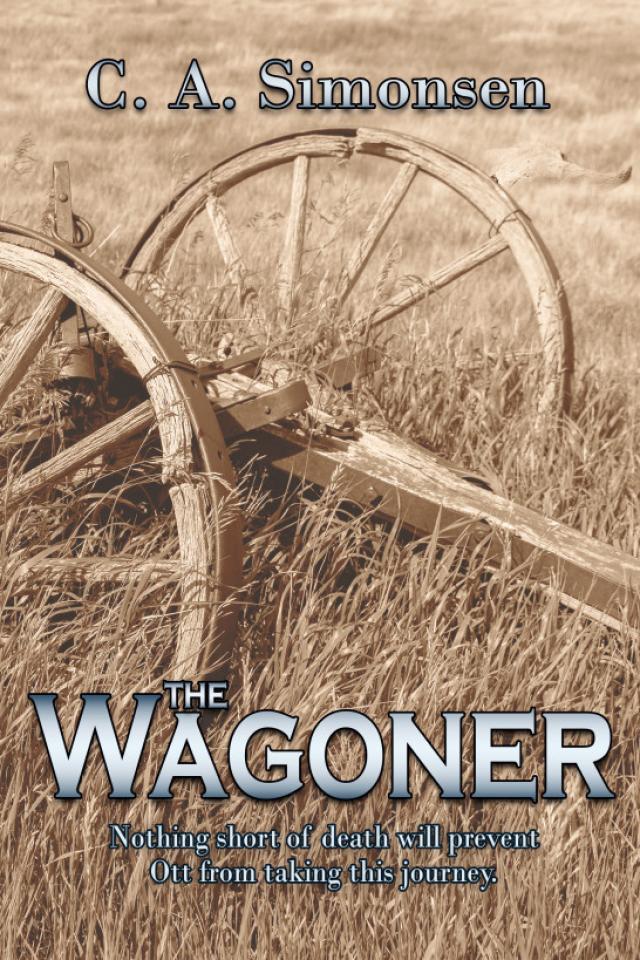
The Wagoner
C. A. Simonsen
Digital ISBNs
EPUB 978-0-2286-1950-5
Kindle 978-0-2286-1949-9
PDF 978-0-2286-1948-2
Print ISBNs
BWL Print 978-0-2286-1947-5
LSI Print 978-0-2286-1946-8
B&N Print 978-0-2286-1944-4
Amazon Print 978-0-2286-1945-1
Copyright 2021 by C. A. Simonsen
Cover art by Michelle Lee
All rights reserved. Without limiting the rights under copyright reserved above, no part of this publication may be reproduced, stored in or introduced into a retrieval system, or transmitted, in any form, or by any means (electronic, mechanical, photocopying, recording, or otherwise) without the prior written permission of both the copyright owner and the publisher of this book.
Dedication
For Samuel, Sophie, Madeleine
Acknowledgement
Thank you to my editor, Victoria Chatham.
Praise to Grant MacEwan's Sitting Bull: The Years In Canada for providing historical accuracy.
Prologue
1777 Sioux Territory
Beneath a rust moon, the aged warrior folded back the flap of hide and slipped out onto the cool ground. Bony-limbed and crouching, he halted.
The braves would be stationed downwind of the encampment, unalerted to action. The People had not seen trouble all summer. It was a quiet night and prosaic. A night like any other. The young sentries would be heavy-lidded, taken with thoughts of the venison which had been dried that day, or possibly of the warm bosoms of their wihingnathun, who lay sleeping curled in furs of moose and antelope.
On feathery feet, the elder made off into the darkness. Unwitnessed.
Pain accompanied his movements. Somewhere along the circuit of his summers, the bones of his hips and back had come to defy him. They cried out when he rose from his warming fire. They gave him sharp stabs if he stirred in his sleep. The People had witnessed his deterioration. Always, the elders were noticed and prized among the People. They were the first in the circle to speak. They were offered the choicest cuts of the ptehchaka roast. Chirping Sparrow had appeared at his teepee in the mornings. She had massaged his naked body with a poultice of the nettle leaf. Like old leather was the skin of her hands on his woeful joints and muscles. Oh, how she talked. Never did the winyan rest her tongue when she came. She complained of the scarcity of berries. The meanings behind the flights of the finches or nuthatches. Often, she droned on of her longing for the winter encampment, where the People had a steady diet of meat.
Eventually, the healer came. He issued herbs and medicinal teas. He would bring the tea to the elder’s lips and tilt the liquid down his gullet. The wise man had performed the smudging ceremony, too, speaking in low tones about wellness and of finding harmony between body and spirit. Still, the elder’s limbs stiffened; he began to seep blood in his waste.
Walking now, the elder lost sight of the teepees. His gait grew more erect. This was how it was with a stubborn body: it needed coaxing, like a beleaguered nag. The wizened Lakota Sioux hobbled on through the black. He had little need of light; he would know the way if he were blind. Even if he were still a boy.
Gradually, the figure was swallowed up by the gloom. The pad of his footfalls emitted no sound. After so many years dedicated to stealth—in the hunt, in the electric thrill of a raid—the hide of his moccasins knew to tread softly. One small step after another. The journey would take all night.
The elder had no need of weapons, nor food. He carried few tokens. The hoop that he had once held and spun in honour of the Great Spirit was too large to carry and hung untouched in his quarters. It had been long since he had joined in the dance. The wolf tooth kept in memory of that stimulating hunt when the man’s blood ran quick, and he suffered the deep wound to his thigh—that too he left behind. The tobacco pipe was an easy thing to transport. A single eagle feather from his headdress, as well. To carry the weight of the full headdress would have been impossible. Plying his way toward the ravine, the elder thought of the war bonnet he had so bravely earned. The beadwork, the bright colours. He saw the wondrous ceremonies during which he had worn it and danced for Mother Earth.
One arrow he carried. It afforded him no protection, for he had not his bow, but the pointed tip was a fond memento of evenings before the fire, chipping and carving flint. Hearing the ancestral songs. Entranced by the ever-changing flames. This particular tip had been crafted from white bone.
He would recognize the outcropping of rock when he saw it. Of this, the elder was certain. It had been some years, but he would know it. A peculiar creation of the mighty Wakan Tanka. One immense slab of rock thrusting up on an angle while another went down into the soil, forming a sort of covered bed. An oversized statue of a clam hidden by wild grasses and cane brush. A person could be standing on the ground of the upper shelf and not see the formation below. The brush was so thick.
The elder had discovered the hidden cavity by chance, during a rabbit hunt. The bison had been fleeting that autumn. As skittish and unpredictable as the spirits. The wakanpi. The scouts had returned to the camp with their heads low. Hunters were dispatched. They rode far in the four directions to locate a herd; they listened to the ground and made the sweet grass prayers. No bison.
Rabbit became their aim. The elder had split from the party. Three or four fat hares zigzagged toward the safety of a dense thicket. Unnerved. The elder, who was not an elder then, had attempted a bow shot and missed his mark. He chased his prey toward the brush and dismounted to investigate the scene. The rock formation lay as if it had been concealed for a purpose by some furtive hand. Tucked away for another day—for a precise time and need.
The People were now moving northwest to the summer grounds. As the bison migrated, so did the People. Daily, they covered many leagues. The old warrior walked steadily on through the night. He was confident that the men would not alter their course and search for him, come the dawn. They would know his mind and respect his decision. He had never spoken of the rock shelf formation. Not even to his wihingnathun: she who had born him three sons. But always, it was there in his mind. A secret place. A bed specially fashioned by the Maker. Revealed only to him. His bed. The People were now travelling close by the site—just when the elder’s body was giving out, and his dreams had been filled with images of his crossing. The elder knew it to be a sign.
The dawn was yet to come when he reached the thicket. Thicket, he saw, was too strong a word now; the lack of rains in the season had dwindled the area to a thin brush. This was a good omen. The withered elder would be able to negotiate the shoots and branches. It was tough going. In the darkness, there were thorny endings that caught on his flesh. Scratched his cheeks and his hands. At one point, he paused for reprieve. Between the distant hoots of the night birds, he heard his own breathing. He felt the sticks that were his legs trembling beneath him.
Pushing through, he sent up a prayer that the People would not wail over him long. They would not have his body to wrap in robes. There would be no slitting of his horse’s throat, for the elder had not owned a mount in ages. The winyan would cut their hair and the songs would go on into the autumn. This was customary and right. Foremost in the elder’s thoughts was the wish that the bison would be plentiful and that the Great Spirit would be manifest in the People’s doings.
When he stood before the outcropping, his knees went weak. The bones of his feet pulsed with pain. They felt brittle, like the ribs of the grouse after sitting too long in the flames. The elder fell into a fit of coughing. When he wiped the spittle from his mouth, he saw that his wrist came away with crimson mucous. He waited for the coughing to subside, then slid his feet forward toward the slope of rock.
There was relief in finding the site unchanged. Why would it not be? The weighty slabs must have been embedded here for eons. Since before the ancestors’ ancestors walked. The slabs were immovable. The elder reached out with a quivering hand. Gently, with a reverence, he put his fingertips to the stone. It was cold and powdery. A swell of emotion overcame the weary wanderer. He had arrived. His final lodging.
He caressed the pebbled bed. Shuffled himself closer so that he could sit and rest. A calm began to penetrate his core. The same calm as when he had first encountered the rock bed, pursuing the nimble hares. The elder’s breathing began to level off. Casting about at his surroundings, he marvelled at how thoroughly he was hidden. Cocooned and safeguarded from the world.
One other item he carried. A pouch of small, coded discs his father had traded for when he was among the southern People. The Sioux hunters had mocked his father for making such a foolish barter. Thin and round, the metal pieces served no purpose. Even as scrapers, they proved ineffective. As a child, the elder had been intrigued by the shiny things. The discs were hard and precisely shaped, decorated on their borders with fine runes. Delicate etchings. Medallions, his father had called them. A word that was difficult for the tongue. The medals were worn and, in places, eroded to a smoothness. Old objects from an unknown tribe. At their centres, the medallions showed one vertical line crossed with one horizontal. For long hours, the child had fingered the discs and wondered at their origins.
Soon, sunbreak would warm him. The elder would be ready for its splendid authority. Its powers. More coughing came. His neck and his back seized with strain. He would wait until he could move again. He would settle into his berth and close his eyes, which had once been so keen—able to spy the ptehchaka on a distant crest, or
1877 Rupert’s Land
Chapter 1 ~ In Which The Wagoner Maligns His Mule
As he swung the saddle blanket up and in, the rear board of the wagon jiggled then toppled to the ground. The board was split lengthwise and brittle with age. The stumpy man stared down at it. A long seam of cracking went through the bolt holes of the plank. This would slow the man’s departure. He mumbled his peevishness and shuffled his way into the barn.
Tethered to a post, the old mule heard the sounds of rummaging and blasphemies. Wood clunking against wood, metal on metal. When the man emerged, he brought an armload of boards of varying lengths. He weaved like a child balancing too many cups and saucers. One after the other, the young man tested the slats into the holding grooves of the wagon. When a slat proved too short, he would flip it over and try it anew, believing that flipping a thing over could make it alter in its physical properties. Often, he mishandled the boards and dropped them on or near his feet. When a splinter stabbed the skin of his palm, the rancher leaped and winced.
“Shit patties! Mm! Chuckleheaded…”
He massaged the small wound and brought it near his face for inspection. The idea of donning gloves came and went. The mule, unimpressed with the spectacle playing out beside him, searched the earth for greenery to latch on to.
Running short of boards, the man—called Ott since he was a wee tyke, growing his first teeth and running barefooted to the river for water—decided it would be quicker to re-employ the original plank, which was the only one of proper size. He could secure the plank with cordage. This fix would be quicker than cutting a new board and drilling new holes. Locating the worn piece, he set himself to fastening it with buckskin rope.
“There ye be,” he said, wiping his brow and hitching up his trousers. “That oughtta hold.”
The rancher loaded the pickaxe and the fire irons. Next to the tinder box, he placed a woolen blanket he would need in the nights. When he thought he’d gotten what provisions and supplies were necessary, he hitched the wagon to the mule and leaned his head against the toe board, which was morning frosted. The sack of a hat which the man wore slid back when he did so, showing a greasy-haired scalp. Ott kept his eyes down, aimed squarely on his badly scuffed boots. He did not move. A gloomy statue was he, miles removed from any other settler. Alone on the Great Plains. A half minute elapsed and the mule waited for instruction. When the statue became a living breathing human again, it fitted its hat better on its brow. When ready, it mounted the seat of the old wagon and took up the reins. They began.
The land was firm with what remained of winter’s freeze. Scattered banks of hard-packed snow clung to the bases of the spruce and the fir, where spruce and fir could be found, though daily the rich soil and wild grasses were revealing themselves further. The timothy and the sedge were awakening. The bravest of the gophers showed their heads, coming back to life.
One of these critters poked its dark eyes precociously from a burrow. It scanned the undulating country, the patches of tufted hairgrass. The gopher’s grey fur was sleek. Its sheen could be glimpsed beneath the muted sun. Down its ball of a crown would dip, then up again in a sort of wary soldiering. As if he alone had been appointed to take stock of the region and report back to the clan—the clan which awaited him inside the dry confines of underground chambers. From the dirt trail came the sounds of heavy steps and a squeaky wagon. The watchdog studied the wagon’s bumpy progress.
The variable breezes gave the creature an indication of the temperature. Of spring’s advance. He measured the air, the scents, the sunlight. Again, the gopher ducked and lifted. Then, in a splurge of mettle, it risked a mad dash across the range. Its extended tail became a flag that sunk and rose with the contours of the land until the scurrying varmint disappeared into another hole—a secret back door to the family tunnels. The hooves of the old mule plodded alongside this private sport, sending up puffs of dust with each drag and fall.
“Get on, ye flunkey,” spat the diminutive driver, following up with boots to the mule’s flanks. “Get-ye. I’s as soon turn ye on a spit. Consarn.”
Ott ejected a stream of juice from the side of his mouth and muttered further on the subject of his perturbedness. The brindled mule, who went by the name Sir Lucien, made on without haste, hanging its black snout low to the ground and flicking the season’s first flies from its ass.
“Addle-headed donkey fucker…”
Ott’s flaccid waistline jerked and sagged with the rhythm of his transport. The skin of his face was pockmarked; the dark moustache and side whiskers he wore were flecked with fragments of ash and thistledown. The man’s nose looked much like a mushroom, his teeth irregular and clay-tinted. On or two of the teeth sat sideways to how they ought. The corpulent neck was fixed to sloped shoulders that would not hold trousers. Try as Ott did, the straps he employed would slide swiftly outwards until they cascaded over the brinks, causing his trousers to drop to his ankles at inconvenient moments. Ingeniously, he had discovered that a knotted length of string could be used in place of the suspenders. Ott had not to be bothered by repeatedly untying the knot in order to do his business, for his trousers were fitted with a trapdoor like those apportioned to his undergarments. The convenience was beatific.
The wagon shook and creaked on the snaky path. The side planks and wheels had been cut by Ott’s granpappy a hundred ages ago, when he’d first arrived on the frontier. Time and weather had diminished the cart. It shimmied and jarred like a decrepit nag made of broken bones. Ott had a mind to secure the loose wheel nuts, but the way was long and he decided it was best to get on.
The driver clawed the hair of his chin and swivelled to look on the wagon’s contents. He fell into a silence before resuming the task of encouraging the mule.
On a low dirt mound amid shoots of weed and field brome, Ott discovered that two of the gophers were now humping enthusiastically. This was of interest. He commanded Sir Lucien to halt but the animal continued forth, heedless. Ott craned to see.
“Curses!” he blared at the mule. “Damned bloomin’ idjit.”
Slowly, they distanced themselves from home and property.
* * *
The wagon path wound close on to the acreage of the Métis. Ott’s backside was beginning to protest but he gave that no regard. The voyage was to be lengthy and trying: he would be forced to suffer his discomforts. From the fence line, he could see a pair of quarter horses tethered to a hitching post. Both were chestnut-coated and broadside to him. Fine, sixteen-hand beasts that kept to the sun and stood contented.
Mingling in a corner of the property were a score of brown hens. They pecked at one another and pecked at the ground and seemed to stab their own feet with their pointy beaks. In sudden, jerky manner they went about, forcing their way through the flock and turning about without warning. Thrusting their breasts, the hens strutted with tails fanned. Moving—always moving—they nibbled on feed and granules of stone.
The wagon dwindled to a standstill.
The Métis was approaching with a bucket of water. The man’s hands were grimy from his work. He bore a buckskin coat in the style of the coureurs des bois. A capote, by name, intricately beaded. Mitasses. A mosaic sash was tied about his waist, holding in place a knife sheaf and a fire bag. The bronze-complected man wore the look of one prepared to contend with any fate which befell him. Cavalry invasion, grasshopper infestation, bubonic plague: it was all one to the Métis. Trotting at the man’s side was an Alaskan Malamute with a thick coat and a curled tail.
The Métis’s wife was a petite Swampy Cree from up in the pines. Ott swooped his head in an effort to locate the woman but found no traces. How the two of them met Ott could not recollect, but he knew it as truth that the woman was a talent with the needle. She had a flare with moccasins and vests. It would’ve been her that had made the Métis’s sash, Ott wagered.






