

Stone, p.1
Stone, page 1


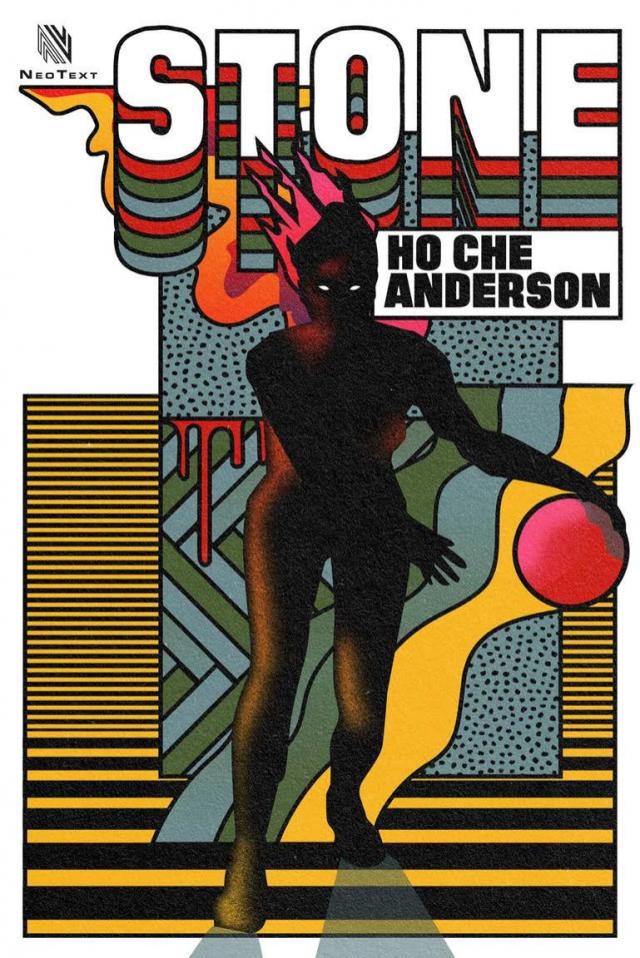
STONE
HO CHE ANDERSON
Based on characters created by OTIS WHITAKER
Illustrated by HO CHE ANDERSON
Cover design by WBYK
Published by NeoText, 2020
Copyright © 2020 Ho Che Anderson and Otis Whitaker
All rights reserved. No part of this publication may be reproduced or
transmitted in any form or by any means without permission of the
author.
All the characters in this book are fictitious and any resemblance to actual
persons, living or dead, is purely coincidental.
1
Elbow to the gut and my face is sliding on polished
maple. I want to throw up. Kowalski, third personal
this half, and not one citation, forget about a foul out, like
the ref’s out to prove a point: you’re on your own in this
world, sister.
Back on my feet and I’m angry, I sprint across the court,
hip check, snatch, hook shot outside the three-point arc.
Air between the ball and net—
—Boom.
Three points.
Mic drop. The crowd chants my name:
“STONE! STONE! STONE!”
2
“Graciela! Graciela!” Papi is yelling ‘cause even though
my alarm’s blasting less than two feet from my ear, I
can’t hear it.
Fuck it—I hear it just fine. I’m just not ready to will this
bod into motion.
“Graciela! You’re meant to open the bodega this morn-
ing,” Papi yells in a weak voice, grasping for its former
strength. He finds it. “GRACIELA!”
Yeah, that’s my name. Gracie O’Leary. The Graciela is
from my mother. The O’Leary is from my dad, the man
yelling at me in that thick-ass Irish accent. This is a man
whose father was born in a sharecropper shack in Alabama.
No one, least no one in the US, would look at him and say
anything but “black.” But he actually grew up in Wexford in
Ireland, after his father got himself an Irish wife while
serving in the US Air Force in Britain, and then moved to
his bride’s home town rather than take his white wife back
to Alabama. Papi’s lived in the flats the last thirty years,
married a Latina woman, runs a bodega, speaks fluent
4
H O C H E A N D E R S O N
Spanish. But he still speaks English with a thick brogue.
Calls himself “Black Irish.” Why? Because he can.
My mom used to laugh at him. You laugh at my dad,
you’re asking for it. Mama’s the only one he’d ever take that
from. She’d laugh in his face and you could see him falling
in love with her all over again. At the time I thought it was
gross.
Mama isn’t around anymore. Been gone since I was
eight, and I’m twenty now. No idea where she is or if she’s
even alive. He tries to hide it, but I know Papi cries over her
every day.
I probably should too. More than likely she’s dead.
Buried in some Mexican jungle, if she was lucky enough to
get a burial. The Big Round Up probably killed her. Or the
cartels.
I should cry for her. But I don’t.
3
La Paz, barely visible behind the boxes of detergent, is
giving herself a bath. Tortoiseshells are my favorite,
but I’ll be honest, this cat’s a bit of a bitch. I’m sucking back
blood from the scratch she gave me on my finger when a kid
in a red hoodie saunters in.
From up the hill. You can just tell. Making sure you can
see his labels. That swagger, based on nothing. You can’t
even grow pubes, kid, that shitty facial hair you’re attempt-
ing’s a dead giveaway. Looking me up and down before
sucking his teeth and walking along the cooler aisle like he
pays rent on the place.
“Yo—you carry malt?” he says. “Old E?”
Eight-thirty in the—
“Sorry, no,” I say. “We don’t get that in the flats. Bud, Bud
Light’s about it. Sometimes Coors.”
“Ain’t got no malt? Damn, son....”
An old lady in a faux-fur coat hobbles in, bee-lines for
the counter. Nods at me, starts rifling through the lottery
tickets, like she’ll recognize a winner when she sees it. I try
to go back to finishing my final civics paper.
6
H O C H E A N D E R S O N
Another kid walks in, also in a hoodie, brown this time.
Avoids my gaze. Glances over at Red Hoodie, still checking
out the cooler. Red Hoodie glances back.
La Paz leaps from her perch beside the detergent and
strolls over to the old lady. Rubs against her leg.
“Hello, little precious!” she says to the little bitch.
Bodega cats, always a hit with the punters, as Papi
would say.
Brown Hoodie says: “Yo—you carry malt?”
I stare at him. Brown Hoodie stares back.
I look over at Red Hoodie. He’s holding a knife, shining a
crooked grin at me.
I look back at Brown Hoodie. Holding a gun on me. An
expensive Heckler and Koch, clattering in his shaking
hands. “Empty the fucking till, bitch,” he says.
There is a weird pause between the old woman seeing
the gun in all its glory and the drawn out “AAGGGHHH!”
that erupts from her.
Maybe it just seems that way because I’m watching this
all in slow motion. It’s happening outside me, like the last
play with eight seconds left on the game clock and down by
one. Maybe it’s because I’m sick of hill rats coming down to
play gangsta among us gutter dwelling flats folks, knowing
that all they gotta do is get out the door and they can hide
behind a wall of lawyers and friendly cops, prosecutors,
judges, all in thrall to daddy’s money. Maybe it’s because just
like in ball, you don’t steal from me, I steal from you. But my
hand is reaching out and grabbing the gun and pulling it
and his arm behind me before I even realize I’m doing it.
The gun fires, I feel the kick, my bones feel for a second
like they’ve turned to powder, and still I don’t let go. At the
same time, I’m pulling the aluminum bat out from behind
the counter where we always keep it and—I’m positive—
Stone
7
fracturing Brown Hoodie’s skull. I look down at him on the
floor clutching his broken head, and there’s already a blood
pool forming underneath it.
The old lady is screaming even louder now. La Paz starts
licking up Brown Hoodie’s blood.
I look over at Red Hoodie. His eyes are saucers. I wonder
absently what my eyes look like right then.
I walk out from behind the counter, holding the bloody
bat. I’ve still got the gun in my hand, and probably I should
point it at him, but in that moment, I forget I’m holding it.
Red Hoodie takes two steps back. “Yo, this—this was his
idea,” he says, choking out the words.
“OK,” I say, walking slowly toward him.
He looks at the weapons in my hands. Drops his knife.
Turns and sprints out of the bodega, the place my mother
and her parents built with their own hands, the place my
father sweats and bleeds over daily, honoring her memory,
honoring the neighborhood she swore to serve. I watch
him go.
I look back at the old lady. She’s stopped screaming now.
Instead, she’s looking at me with an expression I’ve never
quite seen anyone look at me with before.
Is it awe?
Or is it fear?
4
Hours later, after the cops have yawned through my
statement, for some reason satisfied with self-
defense, and sent me on my way, with me knowing that they
will make no effort to find Red Hoodie, and that they’re
stuck with Brown Hoodie only because he was still stunned
on the floor when they got there, that’s when the shakes hit.
In class, right in the middle of me correcting Professor
Prohaska on his Celtic history.
What? You do this for a living and you fuck up your
facts, you need to be called out. I know this is community
college but what are we doing here, playing jumping jacks?
Fact: Boudica. Warrior. Revolutionary. Queen of the
Iceni tribe. After the death of her husband, King Prasutagus,
the Romans renege on the arrangement they have with the
Iceni, strip and flog queen Boudica, and rape her daughters,
all in front of her people. In return she stages a rebellion
against the Romans… that fails.
Fact: Before that failure Boudica unleashed holy hell on
those fuckers. She invaded their cities, killed every living
soul inside and burned those cities to the ground.
10
H O C H E A N D E R S O N
Fact: Boudica did not die in combat on the battlefield. In
the last moments of her existence her spirit broke. The great
queen took her own life, unwilling to give the Romans the
satisfaction of parading her to execution, unable to face the
shame of leading her people not toward their freedom but
toward their slaughter.
Win Jeffers cracks up behind me. “Such a fucking nerd,
Stoner. How you know any of that?”
I turn and glare at Jeffers. “Stoner?”
“I’m curious about that myself, Ms. O’Leary,” Prof
Prohaska says, and you know what, man, I caught that tone,
so just— “Is there something not covered in the research I
provided you want to share with the rest of us? Enlighten us
with your wisdom on this penultimate day of class.”
Asshole.
“And Jeffers—with the language, how many times?”
“Sorry, sir.”
I say, “Prof, my family, we—”
And just like that, as I’m about to show off in front of the
class, they hit. The shimmies, the feel of the bat breaking
Brown Hoodie’s skull, the impact felt right through that
thick triple weave cotton, expensive, so expensive. You think
that douchebag’s family would have had any problem
paying the $25,000 the Merits demanded to not take my
mom in the Big Round Up? You think that fucking hill rat
would ever have had his family threatened like that in the
first place?
“Ms. O’Leary? Gracie, you OK?”
Obviously I’m not OK, I’m shaking, dumbass, can’t you
see I’m shaking?
“I’m good, sir.”
“OK, great, you were saying? Your family? Don’t keep up
all in suspense.”
Stone
11
“Sir—”
La Paz licking up blood. Tortoiseshell fur turned
crimson.
Skull cracking. Latticework, holding its structure,
collapsing.
You’re afraid of me, old woman.
You should be.
I’m gonna yak.
I get up. Heading toward the door. Fuck—
Prohaska, moving toward me, shaking his head at me
from the corner of my eye. By the way, he’s also School Pres-
ident Prohaska.
I puke on him. He lets me graduate anyway.
5
“You didn’t have to close down for the day, did you,
Papi?” I ask.
“Negative,” he says, finishing off the last of the blood pie,
a tradition from the old world that his high blood pressure
demands he not eat and that we can’t really afford. “Once I
got there the constables were winding down their inquiries.
They gave me the go-ahead to re-open. I mopped up, gave
the puss a scrubbing. We were up and running again, by
noon, I’d say. Just past noon.”
Hill rats, but Brown Hoodie had a rap sheet long as my
legs. That’s the only reason the po-po didn’t put me in cuffs
and use me for punching practice just for the hell of it. All
that privilege and so determined to piss it away. Taking it for
granted. Because no matter how low they sink they’ll always
be above the rest of us born down here in the gutter.
Papi’s silent. He’s angry with me. A daughter can always
tell. He’s trying not to show it but he is.
He says: “I’m proud of you, Gracie. You’ve always made
me a proud father. The impulse to protect the bodega...it’s
admirable.”
Stone
13
I look away, waiting.
“But that store...it’s a collection of things, lass.”
“It’s more than just things, Papi. Mama—”
“Would use my privates for blood pudding if she found
out I raised her daughter to throw her life away over a
collection of things.”
I take it in. “I just...acted, Papi. It just happened. I didn't
think.”
“And that’s the problem, lass, you didn’t think, which I
don’t understand, because you’re easily the smartest person
I know.”
What am I supposed to say to that? “Sorry, Papi.”
He straightens his utensils on the empty plate. “Like I
said— I’m proud of you. So proud. We’ll speak no more
of it.”
That works for me. Papi rises and takes his and my plate
to the kitchen. Walking slower than ever these days. “I’ll
wash up, Papi,” I say.
“You’ve done enough today, girl. You rest. This heart’s
still strong enough to conquer a few dishes.”
“You know, I didn’t tell you but I—I had a dream with
Mama in it the other night.”
“Is that right?”
I nod. “I don’t remember much. I walked in a room and
she was just lying there on the couch, watching TV or some-
thing. I was like, Mama? Where have you been, when did
you get here? She’s like, I’ve always been here. Then we just
started watching TV. I don’t remember what we were
watching—a comedy I think.”
“Well, your mother, she appreciated a good laugh, god
knows.”
“Sometimes I play out little games in my head. I imag-
ine, you know, she’s out there somewhere...getting into trou-
14
H O C H E A N D E R S O N
ble. Kicking ass.”
“Out there somewhere—instead of with her family?”
“They’re just daydreams, Papi.”
Except, you know...sometimes I wonder if that’s all they
are. There’s stuff I want to talk with him about but I know
how he gets—so I leave it.
It’s like this: Mama’s parents came from Nicaragua,
fleeing the threat of death and torture from the Somoza
dictatorship, but she was born here.
They were illegal, running for their lives to a country
where they and their children could be safe. They didn’t
take the Merit Party into account. The good old USA they
came to, with the beacon shining across the sea from beside
the golden door and all that, is different today from the
country that Abuelo and Abuelita found.
See, there was a coup. Right before I was born. The Pres-
ident lost the election by five-tenths of a percent. And the
one percent, backed up by the people willing to steal and
kill to join and serve the one percent, finally decided
enough was enough.
Folks had already been worn down by the virus. Four
million dead world wide. Three years of living under a quar-
antine that had turned into martial law before anyone real-
ized, curfews, beatdowns, disappearances, the whole nine.
They’d been saying for years we were due for a big one, but
no one wanted to hear that. And when it hit, at first we’d
given in to our better nature. The government generously
doled out stimulus and benefits packages. Some of it even
made it down to the flats; a bunch of folks suddenly out of
work managed to keep a roof over their heads, for a while,
until a few white men in suits started asking where the
whole thing originated, and, unfortunately for my folks,
other white men in suits came up with the bright idea it had
Stone
15
begun in some Nicaraguan slaughterhouse. And before you
could say Oliver North, the borders slammed shut and the
benefits dried up and the hate crimes flourished at around
the same time the cops disappeared from the flats, never to
be seen again. After all that, the last thing anyone needed
was the fallout from the election.
The President announced that the whole thing had been
a fraud, stolen by people who weren’t even citizens, and he
could not turn the government over to people who had
stolen an election in order to allow the country to be
overrun by thieves, drug dealers, and rapists thronging






