Far cry, p.1
Far Cry, page 1


ADVANCE PRAISE FOR
FAR CRY
“Far Cry is a brilliant, hypnotic work—a collision of invisible, unforgettable lives. It asks what we owe to duty, to family and to love, and gives us the language, and the heart, to bear the beautiful complexity of the answers.” —Madeleine Thien, author of the Scotiabank Giller Prize-winning Do Not Say We Have Nothing
“Beautiful and deeply moving, Alissa York’s Far Cry immerses its readers in the tumultuous early years of Canada’s west coast fisheries, chronicling with meticulous care a world now lost. This is a devastating, fiercely intelligent novel about love, desire and loss, and the secrets that bind them.” —Steven Price, author of By Gaslight and Lampedusa
“Rich and strange—Alissa York’s story is so embodied, real, visceral, you can smell the canneries, feel the strangeness of basking sharks the length of a bus, of salmon whacking the hull of a gillnetter in their shocking plenty. Far Cry rests inside its world with authority and magic, shedding light on what the real and secret lives of women and men must have contained: the confusion, the love, the quicksand of attraction, the poverty and mayhem. The sea.” —Shaena Lambert, author of Petra and Oh, My Darling
“There is a vivid rush of sea air and immediately you are immersed in this finely crafted historical novel, gripped by its world and characters until you reach the powerful, tragic conclusion. This book will stay with me for a long time.” —Adam Foulds, author of The Quickening Maze and Dream Sequence
“Far Cry gives the best gift of fiction: a bracing, electrifying dive into another world, other lives. Period doesn’t enter into it—this is reality. By exact and convincing detail, interior and exterior, York inhabits this fishing life. Not shrinking from pain or violence, she sends her line farther down to create an underlying elegy to the natural world, now so changed. The unstoppable tidal flow of the book’s inevitable conclusion, the knotting and unknotting of the long net these people struggle within—that is true art.” —Marina Endicott, author of The Difference and Good to a Fault
“Far Cry is a mystery set in a small west coast fishing village, wrapped tightly in kelp, unfolding to the rhythm of the sea. Not only did I become lost in a different time, but this novel brought my heart to a new place. I lived inside these characters; their impulses, their losses and their loves were mine. This is historical fiction meticulously crafted by one of our finest writers.” —Claire Cameron, author of The Bear and The Last Neanderthal
“Far Cry is a mystery that only reveals the whole, shocking truth in the final pages, where the pieces come together with an almost audible snap.” —Gil Adamson, author of The Outlander and Ridgerunner
ALSO BY ALISSA YORK
The Naturalist
Fauna
Effigy
Mercy
Any Given Power
PUBLISHED BY RANDOM HOUSE CANADA
Copyright © 2023 Alissa York
All rights reserved under International and Pan-American Copyright Conventions. No part of this book may be reproduced in any form or by any electronic or mechanical means, including information storage and retrieval systems, without permission in writing from the publisher, except by a reviewer, who may quote brief passages in a review. Published in 2023 by Random House Canada, a division of Penguin Random House Canada Limited, Toronto. Distributed in Canada by Penguin Random House Canada Limited, Toronto.
www.penguinrandomhouse.ca
Random House Canada and colophon are registered trademarks.
Library and Archives Canada Cataloguing in Publication
Title: Far cry / Alissa York.
Names: York, Alissa, author.
Identifiers: Canadiana (print) 20220235317 | Canadiana (ebook) 20220235449 | ISBN 9781039002050 (hardcover) | ISBN 9781039002067 (EPUB)
Classification: LCC PS8597.O46 F37 2023 | DDC C813/.54—dc23
Ebook ISBN 9781039002067
Text design: Kate Sinclair
Cover design: Kate Sinclair
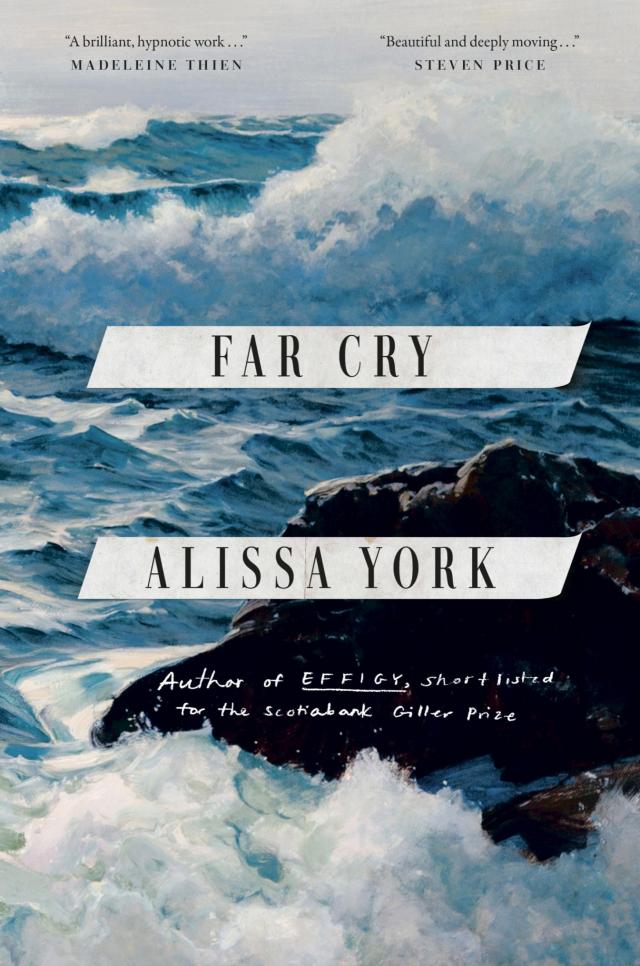
Image credits: The Invading Surf by Frederick Judd Waugh / Artvee.com
a_prh_6.0_142781534_c0_r0
Contents
Cover
Advance praise for Far Cry
Also by Alissa York
Title Page
Copyright
Dedication
Epigraph
Chapter 1
Chapter 2
Chapter 3
Chapter 4
Chapter 5
Chapter 6
Chapter 7
Chapter 8
Chapter 9
Chapter 10
Chapter 11
Chapter 12
Chapter 13
Chapter 14
Chapter 15
Chapter 16
Chapter 17
Chapter 18
Chapter 19
Chapter 20
Chapter 21
Chapter 22
Chapter 23
Chapter 24
Chapter 25
Chapter 26
Chapter 27
Chapter 28
Chapter 29
Acknowledgements
About the Author
A note about the type
for Anne Collins, the right card
and as always
for Clive
But what is the sound of the sea itself? Waves that trickle over a beach or pound against the cliffs and rocks of the weather-beaten coasts? Yes, that’s what the ocean sounds like from land. Underwater it’s a different story.
MORTEN STRØKSNES
Shark Drunk
Rivers Inlet, British Columbia
JUNE 1922
1
This morning the bay is green. Already the water has begun to stink—the yards-wide streak of the shithouse drift, the waste of a hundred incomers or more. In two days’ time the cannery will come clanking to life. There will be blood on the waves, the sky wild with smoke and reeking steam, the wheeling white bodies of gulls.
Time to be getting on. Soon enough some fisherman who has not heard the news will come thudding down the boardwalk and halt to read my handwritten sign. Death in the family.
I have left the shutters closed at the store, and here at the cottage too. It is not always so convenient living next door to your place of work.
I ought to light the stove, warm the old dog lying by its iron feet. Dig out a decent shirt. I wonder, Kit, will you wear a dress? You would feel easier in your work clothes, and is that not what your father would wish?
I would have had his body here, you know that, but you wanted him carried home along the headland path—Knox, Willie and myself each gripping a corner of the oilskin while you insisted on taking the fourth. It was good of Ida to help you wash and dress him. Your father was not a large man, and you have always been strong for your size, but that is no job for a girl to manage alone. Young woman, I suppose I should say. I forget you are eighteen years old.
Burial, too, will be no easy task, especially in this country where the mountains lift up out of the sea. Any open ground is cross-hatched, roots over rock—you know the trouble your mother had scraping up enough soil for her garden. You are right, though, the lookout is a fitting spot. Your father and I walked that trail often enough, clearing deadfall and replacing pipe when the waterline broke. A fair view out over the inlet. And yes, he would never have found his rest at sea.
You are angry with me for how it happened—but, Kit, he would have been in the same state or worse on his own. I will be careful today. On my honour, only one drink before we troop up the mountainside with Frank in his box. Just enough to steady the soul.
* * *
They’re halfway to the lookout before Kit realizes she hasn’t dressed for the occasion. Overalls dragged on over the shirt she slept in, boots. Not that it matters: hardly anyone has bothered to climb the waterline trail. The Pauls have come, of course, Willie and his two sons helping Uncle Anders lug the coffin. Mr. Knox walks behind them, then Ida Paul holding young Annie’s hand. Kit brings up the rear.
It’s no mean feat carving out the grave. They make a start at the base of a windthrown hemlock, the root mass torn up along with whatever foothold the great tree had managed to find. Ida stands alongside her daughter while her husband and sons take turns with Uncle Anders’ spade. Knox gets out his pipe and fills it. Kit feels his glance—sympathy or something like—and steps back out of his fruit-scented smoke.
She’s mostly quiet inside. Still, she feels something slip when Ida puts an arm around Annie and draws her close. A year ago, Kit would’ve had her own mother beside her. Who knows, if Bobbie hadn’t left them, there might’ve been no burial to attend.
Once the men have torn out a scrubby yew, the box goes in. In minutes they’ve filled the shallow trough. Everyone helps drag deadfall to cover the grave—one fair-sized log and a dozen mossy limbs.
When the last branch has been laid, Knox looks as though he might be about to say a few words. Uncle Anders beats him to it, speaking in his old language, something he rarely does. Kit understands nothing beyond her father’s name.
When her uncle falls silent, Knox gives a sorry smile. “Rest in peace, Frank.” He nods to Kit and turns to head back down.
While the others linger, Kit follows the cannery manager, catching up with him along the trail. Knox gives her a searching look before responding to her request. Yes, he can set her up with a fisherman’s licence, if that will make her happy. If she’s sure.
* * *
—
Standing at the end of the long dock, Kit stretches her gaze to the bay’s far shore. Beyond Morden Point, the inlet opens wide. She could walk two docks over, crank up the Dogfish’s engine and steer her out over the deeps. Except that would mean standing where it happened—where she found him face down, floating between the dock and his own boat’s hull.
Her hair flies up on a gust. She tucks the home-cut bob behind her ears. Forget the Dogfish, she needs to get the feel of a company skiff again, now that she’ll be going out with the fleet. She’s had three long years of rowing nothing bigger than the Coot, keeping close to shore. I mean it, Kit, no more than a stone’s throw. Her father wasn’t a rule-maker by nature, but neither was he one to be disobeyed.
Before that, she’d taken her uncle’s rowboat out as far as she pleased. He’s up there now, Uncle Anders, standing some thirty feet above her on the headland, hands on the railing of the storefront porch. She resists the urge to lift her eyes to him, lift her hand. It’s a feeling she’s known all her life, her uncle watching over her. Shame he didn’t keep a closer eye on her dad.
Moving into the cannery’s shadow, she makes her way along the wharf. Men hunker in their skiffs, checking their nets, patching their scrappy sails. A dozen or so kids roam the docks. Not a woman in sight—the fishermen’s wives packing the week’s grub boxes, the washers and packers scrubbing the cannery down. One turn of the clock until the fleet goes out, another until the collector boat steams into the bay with the season’s first catch in her hold.
It’s where Kit belongs, out there over the returning schools. Her father had long trusted her fish sense. She knows how to find them, my girl. She’s got the nose. More like the ear. It was akin to listening, reaching a thought out to where they might be.
Third dock along, Knox said, skiff number forty-four. Kit looses the painter line from the cleat and steps aboard. Already she feels calmer, drifting back from the dock, settling herself on the thwart. Taking up the oars, she pulls a line of narrow strokes until she’s clear of the other boats.
Rowing lets you watch what you leave. Far Cry Cannery and its quarter mile of town strung along the bay’s eastern shore—boardwalk linking shacks to sheds, to proper little cottages with dark-green doors. Steep stairs cut up through the brush to where the cookhouse and the China House jut from the slope. Above it all, the slash of the waterline trail.
On the headland, Uncle Anders’ cottage sits alongside the store. Nothing but boardwalk and scrub from there out to the manager’s house on the point. She’s passing it now, pulling round to come level with the mouth of the bay. A surprise to see the parlour windows open, curtains sucked out to flump on the wind. Of course—Mrs. Knox isn’t there to keep them closed. She’s stayed behind in the city this year, too sick to make the trip north.
And now another unexpected sight: the manager himself, home instead of holding forth at the wake. Stepping out his front door to stand among the flower tubs on the porch, he catches sight of her and waves. Wave back, Kitty-cat—her mother’s voice in her ear, whether Kit wants it or not. Never hurts to have a friend. Kit raises her hand briefly before closing it again on the oar. Knox waves on, as though she’s leaving for good rather than just out for a row. Shit for brains, her father would say if he could.
Kit rows out into the inlet, the mountains tipping up into view. This side of the headland is still mostly wild, her cabin just visible among the trees. She ought to be up there now, checking her gear, resting; a week of gillnetting in the skiff on your own is no joke. She could ask around for a boatpuller, but what man would agree to row for a girl? More to the point, whose company could she stand?
In open water now, she glides for a time, her oars suspended. Evening light, the sea all round her. She’ll manage on her own.
* * *
It was just as well you left before the wake, Kit. Ida was the only woman there, and she and Willie slipped away not long after the bottles came out. Fishermen crowded round the store counter as though it was any weekend night—Japanese and Finns, Scots and Irish, Greeks.
Hanevold and my other Norwegian countrymen were there, come down from Hagensborg on the Bella Coola River in their own skiffs. They joined the itinerant handliners in from every off-channel port, Oweekeenos from the village, city boys come up on the boat.
Talk turned to the coming run. Good signs out on the sound, not a big year, but bound to be better than ’21. I wondered if I would have to remind them why they were there. You know your father was not one to surround himself with friends. Even so, there were men among those gathered who had admired him once, or at least envied him as the man who had married your mother. Drink flowed, and the stories followed. About the way Frank Starratt courted and caught his blue-eyed bride. The way he left Far Cry, and the way he returned.
“He was young to die,” the Hungarian, Balko, put in.
I nodded. “Thirty-nine.” Strange to think, Frank and I were like brothers, but he could have been my son.
Knox arrived in due time, his face arranged in a semblance of respect. One drink and he was ready to take over the talk.
“Oh, Starratt had a temper all right. I’d heard stories long before I set eyes on him. Thought twice about taking him on.”
Yes, Kit, a good thing you were not there. A few more drinks and Knox had cleared the place like a seal come sliding through the school. He held on to the counter with one hand and turned to confront the empty store. After a moment he swung back to me. “Fancy a game of crib?”
It was the last thing I wanted—unless it was to walk next door and sit down at my table alone.
* * *
The cabin is quiet, no one to feed but herself. Kit swallows a mouthful of salmon, sweet and rich. Nothing wrong with fish and porridge, especially when the potatoes have run out. She could save herself the trouble next time, eat at the cookhouse with the other bachelor fishermen. Is there a word for a girl bachelor? Uncle Anders would know.
The last of the porridge now, savoury with butter and salt. Her spoon rings in the bowl. She drinks down her tea, then stands to carry her few things to the basin along with the lamp. Sooner you do them, sooner they’re done. Her mother standing at the kitchen workbench, dark hair hanging down her back. Bobbie Starratt, small like her daughter, a presence in any room. Kit blinks the image away.
The kettle’s still warm. She pours the water and wets the rag, rubbing it over the soap. Looks out into the night. Bobbie loved this window, gazing out over her garden of tubs. Frank and Uncle Anders left a scrim of trees to hold the cliff and manage the wind, but the water still sends its light up through the boughs. Step between the trunks and the world opens wide—the rocky climb down to the spill of sand at the stream mouth, the inlet stretching south before bending west to the sound.
Kit sets her mug and bowl in the basin, her fork and spoon. Lets her hands rest in the warm water. In the dark she can just make out the tubs, raggedy with self-seeding stragglers and weeds. There’d never been any question of digging beds in the rocky clearing. She and Bobbie would range over the headland, scrounging whatever dirt they could carry home.
One early summer morning when they returned with pails in hand, her mother knocked the bottom out of a shallow barrel, leaving a ring of staves secured by two iron hoops. This she set atop the potato tub, a few leaves peeking over its lip. While Kit held the ring in place, Bobbie wrapped the whole structure in sacking. They dumped in the hard-won soil, crowding it round the plants. It looked wrong, smothering the leaves like that, sparing only a handful of tips to gather the light.
“Don’t worry,” Bobbie said. “They like the dark.” She packed down the dirt. “Why don’t you make us some tea.”
Kit would have been seven or so, trusted to feed the stove and boil the kettle herself. She made the tea with the same care she brought to any job—her mother’s sweet and strong in the blue enamel mug, her own milky in the green.