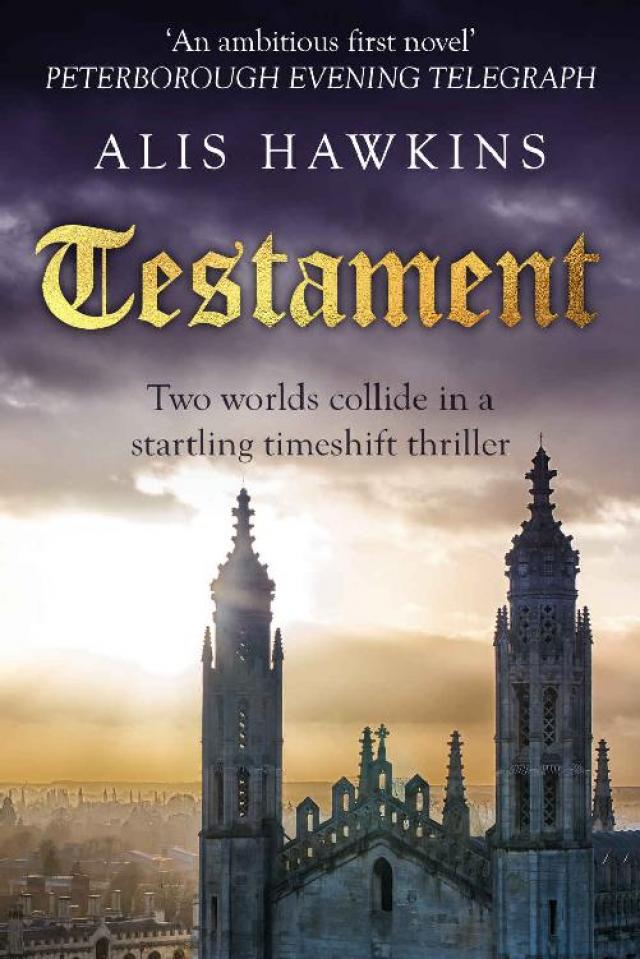
Testament, p.35
Testament, page 35


Henry looked around, as if his words would carry to suspect ears. ‘When the king and his nobles are at odds, how can the people prosper? We will always suffer at the hands of one or the other as they fight for dominance.’
Again, Gwyneth looked at him askance. Henry had always been such an uncritical admirer of nobility. ‘You sound ever more like Simon, my boy.’
Henry pulled a face that tore at Gwyneth’s heartstrings, sending her mind back to the raggedy boy presented to her that day, so many years ago, by her husband. ‘When a man says that the laws of England proceed from his own mouth — whatever he may see fit to say — then I take issue,’ he muttered fiercely. Gwyneth felt his heat — Henry was not a rebel by nature and it would tear at his loyal soul to admit that the king’s insistence that his rule was by divinely ordained right did not sit well with Englishmen. She put a comforting hand on his shoulder.
‘Don’t worry,’ he smiled wanly, turning his eyes to hers, ‘I will be wise with my opinions before others. Never fear, they will not take me up for treason.’
‘Or heresy?’
Henry did not respond directly, but from his face Gwyneth knew that he was thinking of Simon. ‘Have you had word recently?’ he asked.
‘Not since his letter about the third quarry at Kineton.’
‘Do you think he will work out all the stone on the estate for the college?’
Gwyneth shrugged. She had little interest in the stone of Kineton beyond seeing the college finished. Since Toby died she had been blind to the future, seeing only the task before her — that of building the college whose completion he had given his life for.
She had not seen Simon since Christmastide, when she had accompanied Henry, Alysoun and the children to Kineton to spend the twelve days with him there. He had been subdued, asking after the college only in general terms, as if unwilling to incur her displeasure and put in jeopardy the completion of the task. He had outlined his plans for the expansion of stone-cutting on the Kineton estate and given Henry detailed instructions as to barges and men to be sent up at winter’s end, but that had been all. Otherwise, he had played with the children and shown a dedication Gwyneth would have sworn he did not possess in ensuring that the house was comfortable for the family, complete with little chairs for the children, constructed — she had observed with a critical but approving eye — by his own hand.
Simon had been true to his word to her and to Brygge. He had not set foot in Salster or even the countryside around it since the day the mayor had warned him of Copley’s intentions.
‘Does the little hawthorn still grow happily in its place?’ he had asked, standing in the door of the chamber he had given over to her use, as she packed her clothes for the journey back to Salster.
She did not look at him, but her voice cracked as she answered. ‘Yes, Toby’s tree grows still.’
He had moved towards her then and they had come together in an awkward embrace. He stroked her hair and she was comforted, though she was glad that he made no move to extend his embrace. Though her body yearned for the comfort of another’s touch, she could not endure the affections which had once brought a child to life within her.
When Nicholas Brygge walked on to the site later that day, apprehension rose within Gwyneth. Ever the politician, Brygge had kept his distance from the college for both their sakes, though, notwithstanding this precaution, he had taken pains to assure Gwyneth that he would stand protector to her in any way he could while she was deprived of her husband. Until Henry had gladdened her heart by announcing his decision to return to Salster, Gwyneth had been very grateful to think that, should Ralph or anybody else prove troublesome, she had the authority of the mayor to call upon.
‘Master Brygge!’ she hailed him when he was still a score of paces off. ‘Greetings and good day to you!’
He returned her greeting in kind and scrutinised the buildings beneath a shading hand. ‘Soon you will be in need of a roof, will you not?’
Gwyneth shook her head. ‘Not this year. I would not venture to set a roof such as the one I have planned on green walls like these. They need to settle and harden before I ask them to bear weight.’ She sighed as she looked up at the empty space where her roof would rise. ‘And as to the glazing…’ she muttered to herself.
‘The glazing?’ Brygge queried.
Gwyneth turned to him, her mouth open to apologise for speaking her worries aloud, but seeing his expression she closed her mouth and sighed.
‘The endowments will not allow us to glaze the college when the structure is finished,’ she said baldly. ‘We should have to wait several years for the revenues to be sufficient to afford the quantity of glass we need.’ She met his eye briefly. ‘Master Daker had undertaken to provide for this separately.’
Brygge nodded thoughtfully. ‘And, should you be forced to wait too long, the years allowed by the courts will expire, leaving Ralph Daker free to reappropriate his uncle’s lands?’
Gwyneth nodded without speaking, her eyes fixed on the sunlit octagonal building.
‘What does your husband intend?’
‘He says I must trust him. That he will provide for the college.’
‘But you fear that he will not?’
‘I fear,’ Gwyneth responded, all her anxieties about Simon’s intentions welling to the surface in a sudden, fierce flow of emotion, ‘that he will ally himself with those whom the king makes enemies of — those he pursues — those whose words and actions the Church proscribes and seeks to brand heretic.’
‘Lollard sympathisers?’
Gwyneth did not answer directly. ‘Since the Church has now condemned Wyclif’s teachings, England is not safe for those who believe as he did —’
‘It is never safe, Mistress Kineton, to believe something that stands contrary to beliefs commonly held. It is always seen as madness or threat.’
‘But now it puts people outside the Church, under interdict — called heretic!’
Brygge looked full into her face, his eyes calm. ‘Interdict? Heretic? We who believe as we do care nothing for the eucharist of the corrupt Church. Heretic? If it means that a man believes things contrary to the Church’s teaching, then yes, I am a heretic. These words neither shock me nor make me tremble.’
Gwyneth gave him the look of a mother whose child mouths adult phrases the full implications of which it does not truly understand. ‘So you will be neither shocked nor afraid if you are taken into the bishop’s dungeons, Master Brygge? If your office is denied you as being no longer the will of the king and his ministers?’ She continued to hold him with her level, challenging gaze. ‘If you go against the Church, to its ministers you go against God, and if you go against God, then — to the king with his belief in God’s divine ordination — you go against the crown of the land!’
Brygge, his face shadowed by an emotion Gwyneth could not name, looked past her shoulder, as if seeing another figure, as he spoke. ‘The bishop will not touch me and mine unless he wants riots in the streets of his city.’
‘But, friend to me though you are, it is not you I am concerned about but Simon! And myself.’ She looked at him, squarely, her eyes measuring. ‘The mob might riot for you but it would not take to the streets to protect my college.’
Brygge sucked his cheeks in and pursed his lips in thought. ‘Do not underestimate our fellow citizens, Mistress Kineton. Remember the Great Rebellion. We in Salster were not found lacking in rebellious zeal. I believe we, as well as any city in the country, showed that we will not be kept in the place others have decreed for us if we think it unjust.’
Gwyneth waved a hand with a gesture more suited to dismissing improbable gossip. ‘What has that to do with my college, Master Mayor?’
Brygge took her elbow and led her away, through the arch and out of the precincts of the college. Outside, the air was less dusty, the lines of the city wall and the buildings huddled at its base seemed clearer, brighter in the June air, as if drawn with a finer pen. She stood aside to allow passage to a boy struggling with an unwieldy handcart.
‘Mistress Kineton, what are your intentions for the college once it is built?’ Brygge asked, his voice low and soft, intended for her ears alone.
‘My intentions?’ Gwyneth’s gaze travelled, unseeing, over the dusty street before them, her mind racing to formulate an answer that might satisfy him.
‘Let me be more exact. Are you minded to follow Richard Daker’s original purpose? That the endowments may pay teachers and support scholars, so that not only the moneyed may learn?’ Receiving no answer, he pressed on. ‘That the language of instruction shall be English, to make men who can both think and do in the world, not soft-handed men who sit out with the commerce and muse on abstruse things?’
His gaze was insistent on the side of her head which she had turned to him; it seemed to burn into Gwyneth’s neatly tucked coif, and abruptly she swung around to face him, furious that he should set so nakedly before her the dilemma from which she had, for so long, averted her eyes. ‘And how can I follow those intentions? Where am I to find men who will challenge the authority of the Church? Any who will be licensed by the university must be approved by the chancellor!’ Her eyes skewered his. ‘By Copley!’
Brygge did not rise to her tone but kept his voice low and intense, as if it would wrap a weave of invisibility around them, so that the crowds would neither overhear nor even see them standing together in the warm, noisy air. ‘Master Daker did not care to be a part of the university,’ he informed her rapidly in his undertone. ‘He had determined that a new guild of scholars must be established outside the influence of the church. His college was to stand alone, needing no approval, not from Copley nor anyone else in authority.’
Gwyneth stared at him, speechless, as if he had grown a tail and commenced barking.
‘Madness!’ she finally declared and made to march back to her building. But Brygge grabbed her arm and held it as she turned, enraged at his grasp.
He released her and held up forestalling hands in front of his face, as if warding off her angry words. ‘Mistress Kineton, forgive me for laying ungentle hands on you!’ He stood, hands at his sides, plainly waiting to see whether she would stay or go.
Narrowing her eyes and folding her arms across her breast, Gwyneth stayed. Her silence bade him speak his piece.
‘It is not madness, Mistress, it simply has not been done in England. But in Italy, where Master Daker’s grandsire had his business, that is the common way. There, those who would learn hold the reins of those who would teach. It is the student who decides what he wishes to learn and how. It is he who pays the teachers and, as we all know, he who pays the piper —’
‘Calls the tune,’ Gwyneth finished. ‘But Master Brygge, we are not in Italy. We are in England. And, here, the Church pays the masters, and the Church calls the tune. And the Church in this city is Robert Copley. He will never abide such a notion! English elbowing its way in to the place that Latin holds?’ She dropped her voice with her gaze and muttered, ‘It has the taint of Wyclif and his Bible about it.’
‘But what Copley does not see,’ he said urgently, ‘he may wink at! If this teaching in English is done inside the college, and not in the public gaze — if it takes place here, within the hall, instead of in the dean’s hall as the Church’s men do?’
She glared at him. ‘Do you truly believe that he will shut his eyes and leave us be? For I do not!’
Brygge swallowed and his voice was flat and cold. ‘So you will choose only teachers who will be acceptable to Copley?’
‘It is not for me to choose! I will see the college raised, no more!’
‘But if you do not, then who will?’ Brygge begged, his voice tight with a passion she had never heard from him before. ‘Richard Daker is dead, and his heir before him. Ralph is against the mere thought of the college and Anne — the widow — will follow Ralph in all things as it suits her to do. Simon cannot return to the city lest the bishop drag him into the ecclesiastical court and try him for heresy!’ Brygge stared at her and Gwyneth wondered at this coming so close to his own heart. ‘If you do not do it,’ he said, ‘nobody will.’
Fifty-three
From: Damia.Miller@kdc.sal.ac.uk
To: Peterdefries@dmlplc.co.uk
Subject: Prisoner statue
Dear Peter
Thought you’d like to know we’ve found the prisoner statue. It’s now in the care of the daughter of Jack Robinson, former college gardener. It’s currently at the cathedral for conservation and examination. Would you like to come and see it for yourself?
Just let me know and I’ll make the arrangements.
Kind regards
Damia
But, before Peter Defries could reply, Damia received a phone call from the cathedral that sent her scurrying to the precincts.
‘Got your endowments,’ Neil greeted her. ‘It’s all here, papers drawn up and signed by Richard Dacre himself.’ He waved a hand towards the single sheet of parchment on the table in front of them. ‘Just like the other statue, they were hidden in the base.’
Damia bent over the pale brown document with its indecipherable writing. Only one thing could she read: the signature, ‘R Daker’, in a clear hand unconstrained by the conventions of legal script. Richard Daker.
So now the college could prove title, could sell the land if it wished. The rent strike would be brought to an end. She wondered at her own lack of jubilation. But the truth was that the rancour provoked by Hadstowe’s tactics meant that the legal regularisation of affairs would be only the beginning of a long period of bridge-building. Rents might begin to flow into the college coffers again but goodwill would be a long way behind.
‘Interesting thing,’ Neil said, bending over the document. ‘See here? Braddestowe. That’s the village where I took you to see the brasses of Ralph and Anne. Bradstow. I don’t think that’s on your current estate list.’
Damia frowned. ‘No, it’s not.’
‘If Ralph and Anne lived and died there it must have passed out of college control fairly soon after Richard’s death.’
Damia peered suspiciously at the document. ‘Are there others on here that aren’t college lands now?’
‘I’ll make you a list and you can check,’ Neil said. His tone told her he was keen to move on to something else. ‘This wasn’t all we found.’
Moving to a desk at the far end of the room, Neil picked up a rolled document and brought it over to the table.
‘You remember that reference to “Tobit Alms” you found in the Victorian records?’
Damia nodded.
‘I think “Tobit” is a corruption of “Toby’s Obit”. The obit — obituary — was a ceremony marking the anniversary of someone’s death. It was a common practice before the Reformation — usually involved prayers for the dead person.’
‘Toby’s Obit?’
‘From what I’ve managed to read so far —’ Neil nodded at the roll of manuscript on the table between them — ‘this looks like directions for the celebration of an obit ceremony for Tobias Kineton. In perpetuity.’
This college, called Kineton and Daker College — founded by Richard Daker, vintner of the guild and merchant of the city of London, built by Simon of Kineton, master mason, and Gwyneth of Kineton, master carpenter — will be, as long as it stands and men look upon it, a memorial to Tobias Kineton, their son.
Tobias Kineton, looked upon with scorn, called cursed and abomination, was great of heart. His life was a pattern of love and forgiveness, where he was shown hatred and neglect. He loved much and he gave much, as much as any of us is able to give, even unto his own life.
For as John Daker, only son of Richard Daker, died in this place, cut short before manhood, so Tobias Kineton chose his own death as atonement for that other end.
And to his memory, and in both their names, this college was completed.
For each man has his own worth.
Each man, though he be humble and crippled, is equal before God.
Each man must find his place in the world.
And this college stands to equip men, whoever they be, to take that place, to care for the poor and lowly and to remember love, faithfulness and forgiveness, even unto death.
Those whose names will now be called, come forward and accept your alms, given in memory of Tobias Kineton, crippled in body, great of heart.
You who are given these alms in remembrance of Tobias Kineton, will you pray for the continuance and good governance of this college?
Go in peace and remember your vow.
Damia looked up.
‘Tobias Kineton chose his own death as atonement…?’ Her voice sounded husky in her own ears. ‘He committed suicide?’
Neil’s eyes were fixed on hers. He moved his head from side to side, not in denial but in acknowledgement that there seemed no other way to construe the words he had read. He shrugged. ‘That’s the implication, isn’t it?’
‘Do you think… I mean, can he really have made that decision on his own?’
‘Do I think somebody suggested to him that he might like to throw himself into the river as an atonement for John Dacre’s death?’
Damia nodded.
‘I’ve absolutely no idea. We don’t even know the circumstances of John’s death, only that it happened at the college site and appeared to be some kind of accident.’
Damia’s mind, facts bouncing around inside it the way pinballs ricochet around walls and obstacles, suddenly flicked up the image of the river in the wall painting. A river in flood, its browns, blues and greens mingled in an impression of swift, uncontrolled water.
‘He wouldn’t have been able to get himself in and out of his frame, would he?’ She reached out to Neil with her eyes. ‘But in the oval where he’s drowning, the frame is on the bank. Somebody must have helped him!’
Neil thrust his hands into the pockets of his chinos. ‘The wall painting isn’t a literal representation of what happened, Mia. Think of the first oval — that’s not literally how Tobias was born, is it?’ When she did not reply he continued, ‘Whoever did the wall painting probably put the frame on the bank to identify who it was that was in the water.’